

Author: Artur Ragulskyi | CEO & Founder
Reading time: ~12 minutes
When people search for the best value electric dirt bike, many of them are really asking the wrong question.
They ask: "Which bike is cheapest for the most power?"
But that is not the same as value.
Real value is not just about the sticker price. It is about what you get for your money, how well the bike matches your needs, whether it will still satisfy you in 6–12 months, how reliable the brand is, what support exists after purchase, and whether you are buying something you will actually enjoy owning.
After more than 11 years building our own electric bikes, customising components, and comparing brands from the inside rather than only from spec sheets, I can say this clearly:
The best value electric dirt bike is rarely the cheapest one.
Sometimes the cheapest bike becomes the most expensive mistake. And sometimes the more expensive bike is actually the smarter financial decision.
In this guide I am comparing the brands we currently work with most closely: E Ride Pro, Talaria, Altis, and Vector.
Quick Answer
Value depends entirely on what you are buying the bike for. There is no single "best value" electric dirt bike — but there are clear value leaders at each budget level:
|
Budget |
Best value pick |
Key reason |
|
Under €4,500 |
Talaria X3 Pro — €3,790 |
L1e, 55 kg, quality components, lowest real entry price |
|
€4,500–€6,000 |
Talaria MX5 Pro — €5,190 |
Best balance of performance and price in the 72V tier |
|
€5,500–€7,000 |
E-Ride Pro SE — ~€5,400 |
Lightest 72V, L1e, best street+trail all-rounder |
|
€6,000–€7,000 |
E-Ride Pro SS 3.0 — ~€6,450 |
Most complete performance package in the range |
|
Flagship |
E-Ride Pro SR — €6,990 |
Maximum 72V performance — good value if you use that power |
All prices include VAT and free EU delivery. Check vectorebike.com for current pricing.
The worst buying mistake is focusing only on peak power and ignoring battery, suspension, brakes, licensing requirements, dealer support, and how quickly you are likely to outgrow the machine.
So the real answer is this: the best value electric dirt bike is the one that matches your budget, your licence situation, your noise expectations, your riding level, and how quickly you will outgrow it.
What "Best Value" Really Means in Electric Dirt Bikes
Value is not the same as price. A €3,790 bike is not automatically better value than a €7,000 bike — and a €7,000 bike is not automatically better value than the €5,000 alternative.
True value comes from the relationship between three things:
What the bike delivers for how you actually ride. A 25 kW motor has no value for a beginner who needs months to develop throttle control. A 5 kW motor has no value for an experienced enduro rider who will cap its performance within weeks. The power level only has value if it matches the rider using it.
Total cost of ownership over your riding horizon. A cheap bike that requires €1,000 in aftermarket upgrades to ride the way you want costs more than a mid-range bike that works out of the box. And a cheap bike you replace in 18 months because you outgrew it costs more than a machine you ride for four years.
What you give up to reach that price. Every bike involves trade-offs. The X3 Pro's €3,790 price comes with a 60V architecture and a 5 kW ceiling. The SS 3.0's 15.8 kW comes at a price that is €2,600 higher. Understanding those trade-offs honestly is the core of evaluating value.
The clearest question to ask before buying: "At my realistic riding ability and on the terrain I actually ride, will I be using what this bike offers in six months?" If the answer is no, you are paying for value you will not use.
For many riders, value also depends on practical questions that are easy to overlook:
- Do I need a street-legal version?
- Do I need a quiet bike? If yes, that changes the answer significantly — Vector and Altis models tend to run noticeably quieter than the competition
- Do I have the right licence class for the model I want?
- Am I a beginner who needs to develop skill, or an experienced rider who will push limits immediately?
- Do I care more about range, handling, or top-end power?
That is why I would never answer this question without first narrowing down what the rider actually needs. Because if you ignore those questions, "best value" becomes too broad to mean anything useful.
Why Cheap Does Not Mean Good Value
A cheaper electric dirt bike is not automatically bad. But a lower price alone does not prove it is good value either.
There are real costs to cheap machines that do not appear on the price tag:
- Poor battery management systems degrade cells faster
- Weaker frames crack under trail stress
- Generic suspension components do not tune properly
- Brakes that fade on the first descent
- Controllers that fail after 18 months with no replacement parts available
These are not hypotheticals. They are the consistent reasons customers come to us after their first cheap bike.
A word of caution for buyers in the European market: if someone is offering a "new 20 kW electric dirt bike" for €2,000–€3,000, you should immediately understand that something is wrong. In today's EU market, price levels for genuinely well-built machines have largely settled into a realistic range. If something is dramatically below that range, it is either clearance stock, compromised quality, or simply not comparable to what we are discussing here.
Cheap bikes also have a less obvious problem: they teach you the wrong habits. A machine with inconsistent throttle response, vague brakes, and numb suspension does not give you feedback that builds skill. It gives you noise instead of signal. Riders on properly built machines develop better instincts faster, because the machine is actually teaching them something useful each time they ride.
A proven brand with dealer support is almost always better value than an unknown bargain that may become a headache. Every bike in the vectorebike.com lineup — Talaria, E-Ride Pro, Altis, Vector — has established supply chains, spare parts availability, and manufacturer support. When something goes wrong, the question of whether you have a dealer who actually knows the machine is what determines whether a minor fault gets resolved quickly or becomes a costly repair.
Real Price Levels in the European Electric Dirt Bike Market
To evaluate value, you need to understand what actual price tiers exist and what separates them:
|
Tier |
Price Range (EUR) |
What It Represents |
|
Entry-level |
€3,000–€4,500 |
60V architecture, 5–8 kW, L1e street legal, beginner-appropriate power |
|
Intermediate |
€4,500–€6,000 |
72V or 60V advanced, 8–13 kW, trail-capable performance |
|
All-rounder / Sweet spot |
€5,500–€7,000 |
72V, 10–15.8 kW, L1e/L3e options, genuine performance |
|
Premium / Flagship |
€7,000+ |
72V–98V high-power, 22–32 kW, competition-grade components |
Prices at vectorebike.com include VAT and free EU delivery. The 27-month warranty (24 months manufacturer + 3 months dealer) applies across all models — which is itself a meaningful value factor, since warranty coverage directly affects total cost of ownership.
What You Can Realistically Expect at Each Budget Level
The biggest cost driver in an electric dirt bike is the battery. After that, the controller and motor. So if a bike is cheaper, the cost savings almost always come from one or more of these areas:
- Smaller battery capacity (fewer Wh, shorter real-world range)
- Lower battery voltage (less efficient under load)
- Cheaper controller
- Lower-spec suspension
- Weaker brakes
- Simpler component package overall
For off-road-only models, there can also be cost savings because they do not need mirrors, indicators, certification, or road-legal hardware — that alone can reduce cost meaningfully.
Entry Level: €3,790 — The Talaria X3 Pro
What you get: A genuine electric dirt bike with street-legal L1e certification, 5 kW of manageable power, 55 kg weight, and a 60V 40Ah (2,400 Wh) LG battery. It reaches 75 km/h unlocked and covers 50–70 km per charge on mixed riding. The build quality — 6061 aluminium frame, IPM motor, 4-piston hydraulic brakes — is consistent with machines that cost significantly more.
What you do not get: The performance headroom of 72V architecture. You are limited to a 5 kW ceiling. When you want more, you are looking at a new bike, not an upgrade path.
Verdict: Exceptional value for beginners, commuters, and riders who want a legal, low-maintenance machine with genuine off-road capability. The 5 kW ceiling is not a limitation — it is appropriate for the first season of learning.
Intermediate: €4,690–€5,190
Talaria MX4 8kW — €4,690: The same trusted Talaria platform with 8 kW of peak power. A strong choice for riders who want more than the X3 Pro without jumping to 72V.
Talaria MX5 Pro 13kW — €5,190: The first 72V Talaria — and currently the best single value in the mid-range tier. 13 kW through Talaria's gearbox drivetrain, a 72V 40Ah (2,880 Wh) Samsung battery, and three riding modes including Hyper. The gearbox produces smooth, progressive power delivery that makes it accessible for riders transitioning from entry-level platforms and more intuitive than direct hub-drive on technical terrain.
What you get at this tier: real performance — 90+ km/h capability, 40–60 km real-world trail range, adjustable suspension, full hydraulic brakes. A bike that experienced riders will ride for years, not months.
What you do not get: Bluetooth tuning, the higher power ceiling of the SS series, or the weight savings of the lighter SE platform.
All-Rounder Sweet Spot: €5,400–€6,450
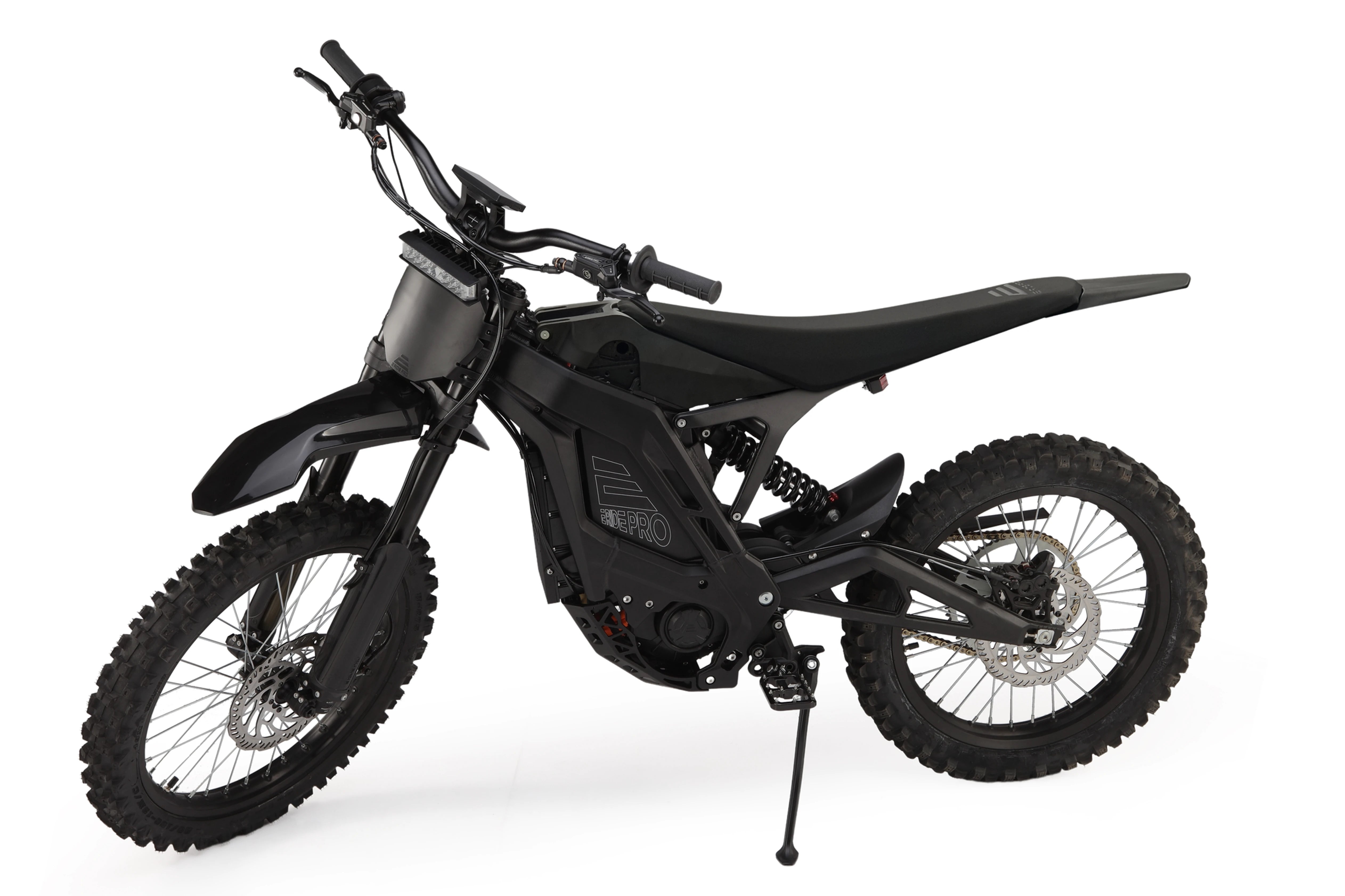
E-Ride Pro SE 10kW — ~€5,400: At 63 kg, the SE is the lightest 72V bike in the E-Ride Pro range. Its 10 kW peak power, L1e certification, and light weight make it the best all-rounder for riders who split time between commuting and trail riding. Accessible from age 15 with an AM licence.
E-Ride Pro SS 2.0 12kW — ~€5,700: The entry point of the higher-power SS platform. 12 kW, 72V, L1e street legal, 63 kg. The strongest choice for German urban commuters who want 72V performance with the lightest possible machine.
E-Ride Pro SS 3.0 15.8kW — ~€6,450: This is where the vectorebike.com range delivers its most complete package for most riders. 15.8 kW peak power, 72V 50Ah (3,600 Wh) Samsung battery — 25% more energy than the MX5 Pro — Bluetooth tuning via smartphone for per-mode power configuration, FastAce fully adjustable suspension, dual L1e/L3e homologation options. With Bluetooth tuning, you can dial the bike down to 50% output for technical riding or building confidence, then unlock full power when you are ready. For most adult riders on most terrain, this is not a meaningful limitation compared to the SR.
Premium / Flagship: €6,650+
E-Ride Pro SR 25kW — €6,990: 25 kW, active liquid cooling, 72V 50Ah (3,600 Wh) Samsung battery, 83 kg. Maximum 72V performance with L1e and L3e certification options. Good value for riders who will actually use that power. Not the right choice for riders who will use it at 40% capacity most of the time.
Talaria Komodo 32kW — from ~€6,650: 32 kW, 97.2V 45Ah (4,400 Wh), full-size motorcycle geometry, L3e or off-road. The highest peak power and largest battery in the lineup. Attractive value for the specific rider who has outgrown 72V platforms and needs full-size ergonomics.
Altis Sigma 22.5kW — from ~€7,409: 98V hairpin motor architecture, 22.5 kW, L1e/L3e/Off-road. The 98V architecture delivers 22.5 kW at lower current than 72V equivalents — meaning less heat and more consistent power delivery under sustained hard use. For riders doing repeated aggressive sessions, this technical advantage has real-world implications.
These flagship models are the best value for one specific type of rider: experienced, skilled, and committed to pushing performance limits. They are not better value than the SS 3.0 for most riders — they are better value only for riders who have already reached the ceiling of 15.8 kW and genuinely need more.
The Five Most Important Things to Compare
If you want to compare electric dirt bikes properly, compare the same categories across every bike. The biggest mistake is comparing one bike's peak power to another bike's battery and a third bike's brand image. That is not a fair comparison.
1. Battery — in Watt-Hours, Not Just Amp-Hours
Battery is the most important value indicator. But the number most often cited — amp-hours (Ah) — is only half the story. Always compare in watt-hours (Wh). A 40Ah 72V battery stores 2,880 Wh. A 45Ah 60V battery stores only 2,700 Wh despite having more amp-hours. The higher-voltage battery is simply physically larger. Multiply volts × amp-hours for a meaningful comparison.
This matters particularly in winter: cold temperatures reduce effective battery capacity by 15–25% at 0°C. If you start with a smaller pack, winter conditions cost you range you cannot afford to lose.
2. Suspension Quality
Suspension quality can completely change how a bike feels. The price difference between a basic spring fork and a FastAce professional unit is real — and it is more noticeable on trail than the difference between 13 kW and 15.8 kW on most sections. One fork may cost a few hundred euros; another costs €1,500–€2,000 as a standalone component. That does not mean every rider needs the most expensive option — but it does explain why two bikes with similar peak power can differ enormously in actual riding value.
3. Brakes
Brakes are not a nice extra. They directly affect confidence, control, and safety. Brakes that fade on a first descent — a real characteristic of budget hydraulic systems — do not just reduce performance, they change how safely and confidently you can ride. All vectorebike.com models use motorcycle-grade hydraulic disc brakes with named calipers.
4. Motor and Controller — Delivery, Not Just Peak kW
Do not look only at peak kW. Look at how the system delivers torque and whether it matches the rider. The Talaria gearbox produces smooth, progressive power delivery that many riders find more intuitive than direct hub-drive at equivalent power levels. The E-Ride Pro SS 3.0's Bluetooth controller tuning lets you configure power curves per riding mode — a feature that changes how accessible and how versatile a machine is across its entire ownership period.
5. Brand History, Dealer Support, and Warranty
A bike that looks impressive on paper but fails after a few months — with no warranty support and no spare parts — is terrible value at any price. The 27-month warranty at vectorebike.com (24 months manufacturer + 3 months dealer), plus two sets of brake pads and extra tyres with every purchase, represents real monetary value. A cheaper bike from an unsupported source with a 12-month warranty often works out more expensive when a component fails in month 15 and there is no one to call.
Complete Comparison: All Models by Price
|
Model |
Price |
Power |
Battery |
Weight |
Street Legal |
Key Value Feature |
|
€3,790 |
5 kW |
60V / 2,400 Wh |
55 kg |
✅ L1e |
Lowest real entry price with quality components |
|
|
~€4,050 |
6 kW |
60V / 1,800 Wh |
~48 kg |
❌ Off-road |
Lightest machine, surprisingly capable |
|
|
€4,690 |
8 kW |
60V / ~2,700 Wh |
~65 kg |
✅ L1e |
8 kW step up on proven Talaria platform |
|
|
€5,190 |
13 kW |
72V / 2,880 Wh |
76 kg |
✅ L1e / Off |
First 72V Talaria, gearbox reliability |
|
|
~€5,400 |
10 kW |
72V / 2,900 Wh |
63 kg |
✅ L1e |
Lightest 72V, street+trail, from age 15 |
|
|
~€5,400 |
10 kW+ |
72V / 3,800 Wh |
69 kg |
❌ Off-road |
Max range, mid-drive, 150 kg load rating |
|
|
~€5,700 |
12 kW |
72V / 2,900 Wh |
63 kg |
✅ L1e |
72V, L1e, lightest SS platform |
|
|
~€6,450 |
15.8 kW |
72V / 3,600 Wh |
75 kg |
✅ L1e / L3e |
Bluetooth, most complete package |
|
|
~€6,650 |
32 kW |
97.2V / 4,400 Wh |
~98 kg |
✅ L3e / Off |
Highest power + largest battery |
|
|
€6,990 |
25 kW |
72V / 3,600 Wh |
83 kg |
✅ L1e / L3e |
Maximum 72V performance |
|
|
from ~€7,409 |
22.5 kW |
98V / 3,430 Wh |
84 kg |
✅ L1e / L3e / Off |
98V architecture, sustained power |
Entry-Level vs Mid-Range vs Premium: A Direct Comparison
|
Criteria |
Entry (X3 Pro, €3,790) |
Mid-Range (MX5 Pro, €5,190) |
Premium (SS 3.0, ~€6,450) |
|
Peak power |
5 kW |
13 kW |
15.8 kW |
|
Battery |
60V / 2,400 Wh |
72V / 2,880 Wh |
72V / 3,600 Wh |
|
Real-world range |
40–60 km |
50–75 km |
60–90 km |
|
Street legal (L1e) |
✅ Yes |
✅ Yes (L1e variant) |
✅ Yes (L1e / L3e) |
|
Bluetooth tuning |
❌ No |
❌ No |
✅ Yes |
|
Suspension |
Adjustable basic |
220 mm adjustable |
FastAce fully adjustable |
|
Best for |
Beginners, commuters |
Intermediate trail riders |
Advanced / all-round riders |
|
Typical seasons before upgrade |
1–2 |
2–4 |
4+ |
|
Total ownership value |
High — if riding style fits |
Very high — broad capability |
Highest — complete platform |
Why the €5,000–€6,500 Segment Is Often the Sweet Spot
For most adult riders who have thought seriously about which machine to buy, the €5,000–€6,500 range delivers the strongest value-to-performance ratio. Here is why this tier is where value concentrates:
72V architecture starts here. The jump from 60V to 72V is not incremental — it is a system change that enables more peak power at the same current, better motor efficiency, and a higher ceiling for future controller upgrades.
Street legality becomes practical. L1e certification at this tier — covering the E-Ride Pro SE, SS 2.0, and SS 3.0 — means you can commute, ride to the trailhead legally, and run errands on the same machine you take off-road. That dual utility is a genuine value multiplier.
Component quality becomes consistent. FastAce suspension, Samsung or LG battery cells, motorcycle-grade hydraulic brakes — these are not aspirational specs at the €5,000–€6,500 tier; they are standard. Below this level, components vary significantly between models.
Bluetooth tuning arrives. The ability to configure power output per mode changes how useful a machine is across its entire ownership period. A 15.8 kW bike tuned to 40% output is a manageable learner's machine. A 5 kW bike with no tuning can only ever be a 5 kW bike.
For around 80% of riders, this range already covers everything they need — without paying heavily for the last 10–20% of refinement or extra power that the flagship tier offers. More expensive does not always mean better value.
What Matters More Than Peak Power
Many customers focus too much on one number: peak power. That is a mistake.
In real life, the riding experience is determined more by:
- Battery quality and watt-hours — which determines how long your session actually lasts
- Suspension quality and adjustability — which determines comfort, control, and confidence on every metre of trail
- Power delivery character — smooth and progressive (Talaria gearbox) vs direct and immediate (hub-drive)
- Weight — 13 kg between the SE (63 kg) and the SR (83 kg) is substantial on technical terrain
- Licensing suitability — a bike that requires a licence you do not have has zero value regardless of its spec sheet
- Noise level — if you need a quieter machine for noise-sensitive environments or hunting use, Vector and Altis run noticeably quieter
- Dealer support and spare parts — which determines what happens when something eventually goes wrong
Peak power above 13–15 kW is relevant only for riders who consistently push performance limits. For most riders on most terrain, it is the least useful buying criterion.
Common Buying Mistakes
Buying by peak power alone. The most frequent mistake. A rider who does not need 25 kW pays for a machine they use at 40% capacity most of the time.
Buying the cheapest bike and calling it value. Cheap is not the same as good value if the bike disappoints, breaks, or teaches you the wrong riding habits.
Comparing amp-hours instead of watt-hours. A 40Ah 60V battery has 2,400 Wh. A 40Ah 72V battery has 2,880 Wh — 20% more energy. Always multiply volts × amp-hours.
Underestimating the value of street legality. Riders who initially do not think they need L1e certification frequently regret it. Being able to ride to the trail legally, commute occasionally, or simply transit on a public road changes how much the bike actually gets used — and therefore its real value per euro.
Ignoring weight as a value factor. The 43 kg difference between the X3 Pro (55 kg) and the Komodo (98 kg) is not just a spec. It is a complete difference in riding character, tip-over recovery, and transport logistics.
Buying too little bike when you already know you progress fast. If you already know yourself — if you know you will want more power in 6–12 months — buying the weaker model first is often poor value. You buy it, outgrow it, sell it at a loss, and buy again. That cycle is usually more expensive than buying the right machine once.
Ignoring brand history and dealer support. A proven brand with a dealer who actually knows the machine is almost always better value than an unknown bargain with no service capability.
Skipping the test ride. Spec comparisons describe a bike on paper. How it feels at low speed, how the throttle delivers power, whether the cockpit fits your body — these are only understood through riding. Test rides are available for all models. Use that option.
Who Should Spend Less and Who Should Spend More?
Spend Less If:
- This is your first electric dirt bike — the Talaria X3 Pro at €3,790 will challenge you for a full season while keeping the stakes of learning manageable
- Your primary use is urban commuting — you do not need 15.8 kW to commute
- You are buying for a younger rider — the X3 Pro and MX4 at €4,690 are sized and powered appropriately for developing riders
- Your budget is genuinely constrained — a €3,790 X3 Pro bought with confidence is better value than a €6,000 SS 3.0 bought with financial stress; ride the bike you can afford to maintain and insure properly
- You do not yet know how serious you will become about riding
Spend More If:
- You have real off-road experience and know you will push the bike — an experienced rider on the X3 Pro will outgrow it quickly; the MX5 Pro or SS 3.0 will serve you for years, not seasons
- You want to commute and trail ride on the same machine — the E-Ride Pro SE at ~€5,400 replaces both a commuter scooter and a trail bike; genuine value when you account for both use cases
- You ride frequently and want to avoid the upgrade cycle — buying the SS 3.0 once is almost always cheaper than buying the MX5 Pro and then trading up in 18 months
- You already know you progress quickly and will want more power soon — buying the bigger bike once is smarter than the buy-outgrow-resell-repeat cycle
- You want Bluetooth tuning and the ability to configure the machine as your skill develops
- You need a more specific legal or performance configuration
German Buyer Notes
For German riders, two additional value considerations apply that buyers elsewhere may not face:
L1e certification multiplies value in Germany. Versicherungskennzeichen for L1e models costs from approximately €45–80/year in Haftpflicht (schwarzes Kennzeichen for 2026/27 Versicherungsjahr from 01.03.2026). No TÜV, no Kfz-Steuer, Class B Führerschein sufficient from age 18. The E-Ride Pro SE and SS 3.0 L1e — which cost more than off-road-only alternatives — also replace a separate commuter vehicle for most urban riders. When you account for both use cases, the L1e premium is almost always justified. See full licensing guidance: Führerschein für E-Bikes in Deutschland.
Off-road access in Germany is restricted. The Bundeswaldgesetz prohibits motorised vehicles on German forest paths regardless of electric operation or noise level. If you have no private land or dedicated MX facility access, an off-road-only model requires trailer transport to every riding location. An L1e model reaches the riding location legally under its own power — which changes the practical value equation significantly.
Final Verdict
Value in an electric dirt bike is not about finding the lowest price. It is about finding the model where every euro you spend is being used — by your riding, your terrain, your skill level, and your legal situation.
The most common mistake is buying for the power you aspire to rather than the power you will actually use in the next 12 months. Be honest about where you are as a rider, not where you hope to be.
From the current vectorebike.com lineup, the clearest recommendations:
- Best entry value: Talaria X3 Pro at €3,790 — genuine quality, L1e, 55 kg, exceptional first machine
- Best mid-range value: Talaria MX5 Pro at €5,190 — strongest performance-to-price in the 72V tier
- Best all-round value for most adult riders: E-Ride Pro SS 3.0 at ~€6,450 — 15.8 kW, Bluetooth, 3,600 Wh, L1e/L3e, 4+ seasons of useful ownership
- Best value for riders who will soon want more: E-Ride Pro SR at €6,990 or Altis Sigma — buy once rather than upgrade twice
- Best ultra-entry value: E-Ride Pro Mini at ~€4,050 — surprisingly capable for what it offers at that price
A bike is only good value if it is still the right bike after the excitement of the first week is gone. That is the real test.
All models are available at vectorebike.com with free EU delivery, 27-month warranty, 2 sets of brake pads, and extra tyres included. Test rides are available — strongly recommended before any purchase decision.
FAQ
What is the best value electric dirt bike?
There is no single answer — but for most adult riders planning regular trail riding, the E-Ride Pro SS 3.0 at ~€6,450 offers the best overall combination of performance, features, battery, and dual street/off-road legality. For beginners or budget-conscious buyers, the Talaria X3 Pro at €3,790 is the best value at its price point by a significant margin.
What price range offers the best balance of value and performance?
The €5,000–€6,500 range. This is where 72V architecture, consistent component quality, street-legal options, and Bluetooth tuning all become standard — and where the total-cost-of-ownership argument for spending more becomes stronger than the argument for spending less.
Is an entry-level electric dirt bike enough for most riders?
For beginners and casual riders, yes. The Talaria X3 Pro or MX4 provide more capability than most developing riders will use in their first season. The honest limitation is the 60V power ceiling: riders who progress quickly will feel it within 12–18 months.
When is it worth paying more for a premium model?
When you have the skill to use the additional capability and ride frequently enough to justify the higher purchase price. An experienced rider who rides twice a week genuinely benefits from 15–25 kW. A beginner who rides once a month does not.
What matters more for value: power, battery, or weight?
For most riders, battery capacity (in Wh) and weight matter more than peak power. Battery capacity determines how long you ride per charge. Weight determines how the bike handles in every low-speed and recovery situation. Peak power above 13–15 kW is relevant only for riders who consistently push performance limits.
How do I know if a bike is overpriced?
Compare watt-hours per euro, verify that the warranty is backed by an authorised EU dealer with real service capability, and confirm that components — battery cells, suspension brand, brake system — are from known suppliers rather than generic alternatives. A bike with impressive peak power but unknown battery cells, no dealer support, and a 12-month warranty is almost always overpriced regardless of its price tag.