



Author: Artur Ragulskyi | CEO & Founder
Reading time: ~12 minutes
Off-road riding is what every model in the vectorebike.com lineup was originally built for. The machines in this guide are not road bikes adapted for occasional trail use — they are high-performance electric motorcycles designed from the ground up for loose surfaces, technical terrain, elevation changes, and conditions where instant torque and long-travel suspension matter more than any road-speed governor. This guide ranks the six strongest choices for pure off-road use across the full vectorebike.com lineup, from the best value entry platform to the highest-power machine available.
Quick Answer
Top 6 electric dirt bikes for off-road riding from vectorebike.com:
|
Model |
Price (EUR) |
Power |
Battery |
Weight |
Road Legal? |
Best Off-Road Use |
|
from €6,190 |
32 kW |
97.2V 45Ah / 4.4 kWh |
~98 kg |
L3e / Off |
Max power, full-size MX |
|
|
€6,990 |
25 kW |
72V 50Ah / 3.6 kWh |
83 kg |
L1e / L3e |
Max performance + road-legal option |
|
|
~€5,400 |
10 kW+ |
72V 52Ah / 3.8 kWh |
69 kg |
Off-road |
Max range, mid-drive, built for long-term durability |
|
|
check current listing price |
15.8 kW peak |
72V 50Ah / 3.6 kWh |
75-76 kg |
L1e / L3e |
Best dual-use: trail + road transit |
|
|
€5,190 |
13.4 kW |
72V 40Ah / 2.88 kWh |
76 kg |
L1e / Off |
Gearbox agility, technical terrain |
|
|
€3,800 |
8 kW |
72V 30Ah |
~48 kg |
Off-road |
Lightest platform, MX tracks, youth |
All prices include VAT and free EU delivery. Off-road-only models cannot be ridden on German public roads — see the Germany section for legal context.
What Makes an Electric Dirt Bike Good Off-Road?
Off-road performance in an electric motorcycle comes down to five measurable factors — and understanding them explains why the rankings below are ordered the way they are.
Peak power and torque delivery. Off-road riding demands power that is available instantly from zero RPM — not power that builds through a rev range. Every electric motor delivers instant torque from standstill, which is a fundamental electric advantage over petrol alternatives. But the quantity and controllability of that torque varies significantly across the lineup: from lightweight lower-power platforms to full-size 32 kW machines like the Talaria Komodo. At the top end, 32 kW means full-size motocross-level performance. At the lower end of the lineup, lighter and more approachable platforms remain easier to manage, but are naturally more limited on steep climbs and sustained high-demand terrain.
Battery capacity and real-world off-road range. Off-road riding consumes significantly more energy per kilometre than road riding. Aggressive throttle, steep climbs, loose terrain, and sustained high-current demands combine to produce consumption of 0.10–0.25 kWh/km — two to five times the road consumption rate. A 2.4 kWh battery that covers 60 km on road may only produce 35–45 km of aggressive off-road riding. The models with 3.6–4.4 kWh batteries have the clearest advantage for extended sessions.
Suspension specification and travel. Long-travel adjustable suspension absorbs terrain impacts that would otherwise translate into loss of control. The premium models in this guide carry 200–220 mm of suspension travel with professional-grade adjustability — FastAce, DNM USD8SA, competition-grade units. Entry models have shorter travel (160–170 mm) that limits their capability on aggressive terrain.
Frame and motor thermal management. Off-road riding generates more heat than road use — more current, more sustained demands. High-end models include active cooling (E-Ride Pro SR), oversized thermal-management designed systems (Altis Sigma's 98V architecture), and motor designs with substantial headroom above operational load. Budget motors overheat on sustained aggressive riding; these motors do not.
Weight and power-to-weight ratio. 55 kg at 6 kW is very different from 98 kg at 32 kW. For technical, tight terrain, lighter machines (E-Ride Pro Mini, Talaria X3 Pro) are more manoeuvrable. For high-speed open terrain, heavier machines with more power maintain stability and confidence better. The right weight-to-power combination depends on your specific terrain and riding style.
Off-Road Riding in Germany: What the Law Actually Allows
This section is essential for German buyers. Off-road riding is significantly more restricted in Germany than in many other countries, and understanding the rules before purchasing avoids expensive mistakes.
The core rule: Bundeswaldgesetz (Federal Forest Act) and Landeswaldgesetze. Motorised vehicles are prohibited from riding in German forests on public paths and trails. This applies to all motorised vehicles — including L1e and L3e certified e-motos — regardless of noise level or emissions. The electric operation of these bikes does not create a legal exception. Violations are subject to fines and can result in the bike being impounded.
State-level enforcement specifics:
-
Bayern (Bavaria): §17 Bayerisches Waldgesetz — strict prohibition of motorised vehicles on forest paths not designated as public roads
-
Baden-Württemberg: §37 LWaldG — similar prohibition with active enforcement by Forstbehörden
- Nordrhein-Westfalen: §2 LForstG NRW — motorised vehicles prohibited on forest paths
What IS legal off-road riding in Germany:
-
Private land with owner permission: Riding on land where you have the owner's explicit consent — your own property, a friend's farm, agricultural land with permission
-
Dedicated MX facilities and tracks: Germany has a number of licensed motocross facilities where track riding is permitted. A list of licensed tracks is maintained by regional motorsport associations
- Agricultural and forestry work on private land: Vehicle owners with agricultural or forestry operations on their own land have different access provisions than recreational riders
The practical German off-road setup: Most German riders who want genuine off-road access either own or lease private land, have access to a dedicated MX facility, or transport the bike by trailer or van to riding destinations — often in neighbouring countries (Austria, Czech Republic, Poland, France) where trail access is more permissive.
For models with L1e or L3e road certification, an important advantage in Germany: the bike can be legally ridden to a trail access point, ridden off-road on permitted terrain, and ridden home legally. Off-road-only models (Vector Vortex, E-Ride Pro Mini) require trailer transport to the riding location. Full legal context: Electric Dirt Bike vs Electric Off-Road Bike in Germany.
The Full Ranking: Top 6 Off-Road Electric Dirt Bikes
#1 — Talaria Komodo 32kW: Maximum Power, Full-Size Off-Road Geometry
Talaria Komodo 32kW L3e / Off-road from €6,190 | 32 kW peak | 97.2V 45Ah (4.4 kWh) | ~98 kg | Competition-grade suspension | ✅ L3e available
The Talaria Komodo leads this ranking because no other model in the vectorebike.com lineup combines 32 kW of peak power with a 4.4 kWh battery in a full-size motorcycle geometry platform. This is a completely new Talaria platform — not an upgrade of the Sting — built from the ground up for riders who have outgrown smaller machines and want full-size performance in an electric package.
32 kW in off-road context. 32 kW (approximately 43 hp) delivered from zero RPM is the power level where meaningful comparison to 250cc petrol motocross bikes becomes appropriate. The Komodo climbs gradients that stop lesser machines, accelerates out of corners faster than any 72V alternative in the lineup, and sustains performance under the sustained high-current demands of technical trail riding better than lower-voltage competitors. The 97.2V architecture means less current at equivalent power — which means less heat, less voltage sag, and more consistent output across a full session.
4.4 kWh battery — the largest in the lineup. At aggressive off-road pace (0.12–0.18 kWh/km), the Komodo's 4.4 kWh battery delivers approximately 24–37 km of genuine motocross-intensity riding before significant depletion. At moderate trail pace (0.07–0.10 kWh/km), this extends to 44–63 km — a full morning session with margin. For extended trail riding, the Komodo has the largest energy reserve available.
Full-size geometry. Adult proportions — longer wheelbase, taller seat, wider handlebar position — sized for riders 175 cm+ who have found smaller platforms cramped. Long-travel competition-grade suspension absorbs the high-speed impacts that come with 32 kW of available power.
In Germany: L3e certification available — full motorcycle registration at Zulassungsstelle, TÜV, Kfz-Steuer, motorcycle licence required (A1, A2, A, or B196 Erweiterung for eligible Class B holders aged 25+). Off-road configuration available for track or private land use without road certification. For German riders with private riding land or dedicated MX facility access and a motorcycle licence, the Komodo L3e allows legal riding to the site and full performance on arrival.
Best for: Experienced riders with petrol MX background; tall riders who need full-size geometry; riders who have outgrown 72V platforms; German riders with motorcycle licences and private land or MX access.
#2 — E-Ride Pro SR 25kW: Off-Road Performance with Road-Legal Flexibility
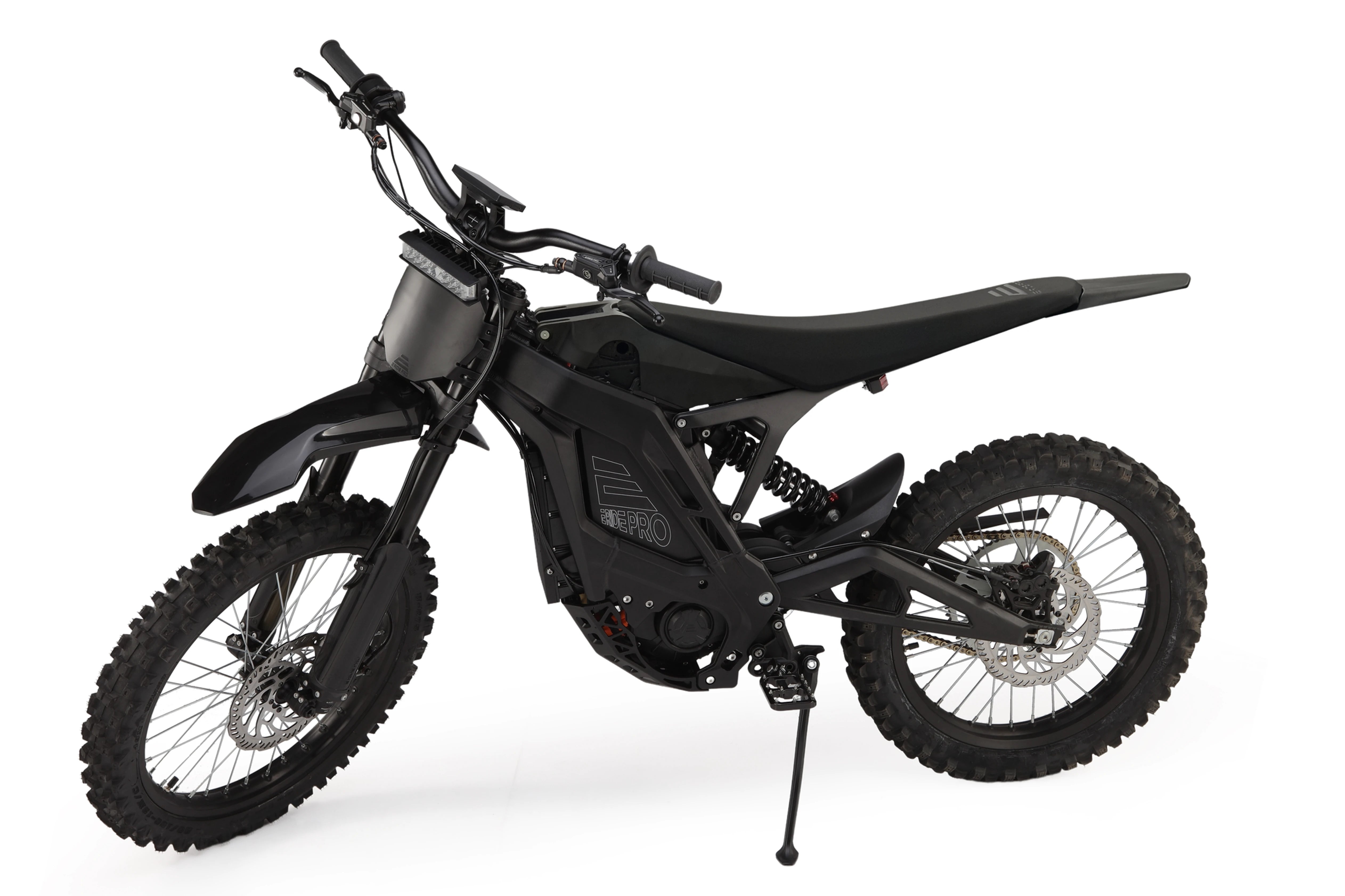
E-Ride Pro SR 25kW L1e / L3e / Off-road €6,990 (sale; regular €7,790) | 25 kW peak | 72V 50Ah (3.6 kWh) Samsung 50S | 83 kg | Max load: 137 kg | ✅ L1e / L3e
The E-Ride Pro SR is ranked second not because it is less capable off-road than the Komodo, but because its most distinctive attribute — road-legal L1e certification at 25 kW — is specifically relevant to German riders who need legal transit to and from their riding location. On the trail itself, the SR's 25 kW, active cooling system, and FastAce suspension deliver a performance level that satisfies the most experienced off-road riders.
25 kW on trail. 0–48 km/h in approximately 1.8–2.0 seconds. The SR produces wheel torque that lifts the front at full throttle from a standing start. This is not a beginner's machine in any configuration. In Boost mode, it demands the same respect and throttle discipline as a high-performance petrol enduro bike.
Active cooling system. Unlike the SS 3.0 and SE, the SR includes an active liquid cooling system specifically designed for sustained high-power off-road use. On extended technical sessions where sustained current draw generates heat, the SR's cooling manages motor temperature more effectively than passive systems — allowing longer sustained performance before thermal limiting.
The road-legal advantage for German off-road riders. For a German buyer without a trailer, the SR L1e allows legal riding on public roads at 45 km/h en route to a private property or MX facility — battery depleted only by the road transit, not by the off-road session itself. This practical logistics advantage is not available on off-road-only models.
In Germany: L1e: Versicherungskennzeichen, Class B from age 18, no TÜV. L3e: motorcycle licence, Zulassungsstelle registration. Off-road version: no road use.
Best for: Riders who want 25 kW off-road performance with the option of legal road transit in Germany; those who value active cooling for sustained high-power sessions; experienced riders who want the most capable road-legal off-road machine available.
Full review: E-Ride Pro SR Review
#3 — Vector Vortex 10kW: Maximum Range and Mid-Drive Engineering
Vector Vortex 10kW Off-road ~€5,400 | 10 kW+ peak | 72V 52Ah (3.8 kWh) Panasonic | 69 kg | Max load: 150 kg | ❌ Off-road only
The Vector Vortex takes position #3 on a different criteria from the top two: not peak power, but engineering philosophy, maximum range, and long-term durability. It is the most distinctive machine in the vectorebike.com lineup — designed in Munich, manufactured to their specifications, and built to a different brief than the Talaria and E-Ride Pro platforms.
Mid-drive motor on the swingarm. The Vortex's defining mechanical feature: the motor mounts directly on the swingarm rather than at the rear axle. This keeps chain tension constant regardless of suspension compression depth — eliminating the need for a chain tensioner and producing handling balance that experienced riders consistently describe as closer to a petrol dirt bike than any hub-drive alternative. Weight distribution is centralised rather than rear-biased, which directly improves handling on technical off-road terrain.
3.8 kWh Panasonic battery — 200+ km manufacturer claim. At 35 km/h average trail speed, the Vortex's manufacturer claims 200+ km. In realistic moderate off-road use (0.07–0.10 kWh/km), this translates to 38–54 km of riding. At aggressive pace (0.12–0.18 kWh/km), 21–32 km. The battery can also be upgraded: vectorebike.com has built custom 5.5 kWh packs for Vortex clients, fitting within the oversized frame without modification.
150 kg maximum rider load. The highest load rating in the entire lineup. The oversized high-strength steel frame is designed for heavy adult riders — a specification that most e-motos in this category simply do not match.
Kelly 300A controller with sprocket tunability. The Kelly controller allows mechanical tuning via sprocket selection — short sprocket for maximum torque (technical, steep terrain); longer sprocket for higher top speed (open terrain). This mechanical flexibility is absent from competing hub-drive platforms.
In Germany: Off-road only. No road certification — cannot be ridden on German public roads. Use is limited to private land with permission, dedicated MX facilities, or other clearly permitted off-road access. Transport to the riding location requires a trailer or van.
Best for: Riders prioritising long-term durability and range over peak power; heavier adult riders (80–120+ kg); private-land users with legal riding access; riders who want maximum upgradeability.
Full review: Vector Vortex Review
#4 — E-Ride Pro SS 3.0: Best Dual-Use Trail Machine
E-Ride Pro SS 3.0 15.8kW L1e / L3e / Off-road check current listing price | 18 kW peak | 72V 50Ah (3.6 kWh) | 75–76 kg | Max load: 137 kg | ✅ L1e / L3e
The SS 3.0 ranks fourth in the off-road-specific list — not because its trail performance is inadequate, but because its strongest attribute is dual-use flexibility rather than pure off-road maximisation. With a 3.6 kWh battery and a genuinely high-performance platform, it delivers off-road performance that intermediate-to-advanced riders find engaging and challenging. The same machine carries L1e certification for German road transit, making it the strongest practical choice for riders who need both.
Off-road capability in practice. The SS 3.0 has enough power for aggressive technical trail riding, significant climbs, and serious off-road use, while still remaining easier to manage than the higher-output SR and Komodo. It is not 25 kW or 32 kW — the ceiling is real. Riders who consistently hit the power limits of the SS 3.0 and want more are ready to step up to the SR or Komodo. But most trail riders do not push that ceiling regularly, and the SS 3.0's power-to-weight balance is very strong within its tier.
3.6 kWh battery for off-road sessions. At moderate off-road pace (0.07–0.10 kWh/km): 36–51 km before significant depletion. At aggressive pace (0.12–0.18 kWh/km): 20–30 km. These are realistic numbers for a focused morning or afternoon session with a return buffer. The same battery covers 80–100 km on road at 45 km/h, which is useful for German riders transiting legally to their riding location.
FastAce suspension — same spec as the SR. The SS 3.0 carries the same FastAce fully adjustable suspension as the flagship SR — not a downgraded variant. This matters on technical terrain where suspension tuning to rider weight and terrain type directly affects control and confidence.
In Germany: The SS 3.0 L1e is the model that solves the German off-road problem most practically: ride legally to private land or MX facility, arrive with 60–70% of battery remaining for the session, ride off-road, return legally. No trailer required. Versicherungskennzeichen + Class B licence.
Best for: German riders who want to ride to and from their trail location legally; intermediate-to-advanced trail riders who want genuine performance without needing the SR's 25 kW; the most practical all-conditions choice for mixed road/trail German ownership.
Full review: E-Ride Pro SS 3.0 Review
#5 — Talaria MX5 Pro 13kW: Technical Terrain Agility
Talaria MX5 Pro 13kW L1e / Off-road €5,190 | 13.4 kW peak | 72V 40Ah (2.88 kWh) Samsung 50S | 76 kg | 220 mm suspension travel | ✅ L1e / Off-road
The Talaria MX5 Pro earns its position through riding character rather than raw specification. 13 kW through Talaria's proprietary gearbox and primary chain drive produces power that experienced trail riders consistently describe as more intuitive and satisfying on technical terrain than direct hub-drive alternatives. The gearbox mediates the power delivery, producing a progressive surge rather than an on/off switch — a characteristic that improves traction management on loose, technical surfaces.
Gearbox advantage on technical terrain. On tight singletrack, roots, rocks, and unpredictable loose surfaces, throttle precision matters more than peak power. The Talaria gearbox's mediated output allows more nuanced throttle inputs than direct hub drive at the same power level — which is why experienced trail riders with petrol MX backgrounds often find the Talaria's character more familiar and controllable.
220 mm suspension travel. The MX5 Pro's long-travel fully adjustable suspension is properly sized for aggressive off-road use — not trail-spec units marketed as off-road capable. 220 mm of front and rear travel handles drops, G-outs, and rough high-speed terrain with the compliance needed for confident riding.
Battery and range trade-off. The MX5 Pro's 72V 40Ah (2.88 kWh) battery gives it more energy headroom than a smaller legacy setup, but it still offers less range reserve than the largest-battery models above it in this guide. For focused trail sessions at a local property or MX facility, this is adequate. For longer expeditions or mixed road-plus-trail German outings, the smaller battery is the primary limitation.
In Germany: L1e certification available for legal road transit. At €5,190 it is the most affordable model in this guide with 13 kW and L1e access — particularly relevant for German riders who want meaningful off-road performance with legal road transit at the lowest available price in this performance tier.
Best for: Experienced trail riders who value gearbox character and throttle precision on technical terrain; riders transitioning from petrol dirt bikes who find hub-drive power delivery less natural; German riders who want 13 kW of off-road performance with L1e road access at the lowest price point.
Full review: Talaria MX5 Pro Review
#6 — E-Ride Pro Mini 8kW: Lightest Platform, MX Tracks and Youth Riding
E-Ride Pro Mini 8kW Off-road €3,800 | 8 kW peak | 72V 30Ah | 49 kg | 680 mm seat height | ❌ Off-road only
The E-Ride Pro Mini occupies a specific position in this off-road guide: the lightest, most accessible machine in the lineup, with one of the lightest chassis in the lineup and a compact battery platform designed for shorter, more focused off-road sessions — but with component quality (FastAce suspension, Samsung cells, hydraulic disc brakes) that matches machines twice its price, and a design brief specifically oriented toward MX track use, young riders, and adults who want a physically manageable entry platform.
49 kg — the weight advantage. At 49 kg, the Mini remains dramatically lighter than the larger adult platforms in this guide. On an MX track or private property where the goal is skill development, low-speed technique practice, or accessible recreational riding, lighter weight is directly enabling: tip-over recovery is manageable alone, the bike can be lifted over obstacles, and slow-speed control is less physically demanding.
210 Nm wheel torque in a compact package. The compact high-torque motor setup is tuned for smooth, progressive throttle development rather than intimidating peak output. Two footpeg position options (adult and youth) allow the same machine to serve different rider sizes. The 680 mm seat height is the lowest in the lineup, creating confident foot placement at low speeds for smaller riders.
FastAce suspension and Samsung cells. Despite the entry price, the Mini carries FastAce adjustable suspension and Samsung battery cells — the same component calibre as the larger E-Ride Pro models. This is not a budget machine in terms of component quality; it is a purpose-scaled machine for the specific brief of lightweight accessible off-road riding.
The battery limitation. The Mini’s compact battery setup is designed for shorter sessions, MX track riding, and repeated practice use rather than long trail loops. At off-road pace, expect 30–45 km per charge — shorter than a typical trail session for adults. The Mini is best suited to repeated short sessions with charging intervals, MX track laps, or property riding where a charger is nearby.
In Germany: Off-road only — no road certification. Requires private land, dedicated MX facility, or other legitimate off-road access. The Mini fits easily in a standard estate car or van boot without disassembly, which simplifies transport to German MX facilities compared to larger, heavier machines.
Best for: Young riders on MX tracks; adult beginners building off-road technique; riders who want the lightest manageable quality platform; German families who want a proper (not toy) machine for a teenager or smaller adult.
How Different Off-Road E-Motos Fit Different Riding Lifestyles
|
Riding style |
Best match |
Why |
|
Competitive MX, max power |
Highest power + largest battery |
|
|
Hard enduro, sustained sessions |
Active cooling, 25 kW, road-legal |
|
|
All-day trail, max range |
3.8 kWh, mid-drive, 200+ km |
|
|
Trail + legal road transit (Germany) |
high-performance platform + L1e road access |
|
|
Technical singletrack, gearbox feel |
Gearbox character, 13.4 kW |
|
|
MX track, skill building, lightweight |
49 kg, compact, low-consequence learning |
|
|
Heavy adult riders (80–120+ kg) |
150 kg max load rating |
|
|
German hunters with Jagdrecht |
Vector Vortex or SR |
Silence, range, or road access |
Off-Road Performance Comparison: Key Specifications
|
Model |
Power |
Battery |
Off-road range (est.) |
Suspension travel |
Max load |
|
32 kW |
4.4 kWh |
44–63 km moderate |
Competition-grade long-travel |
high |
|
|
25 kW |
3.6 kWh |
50–75 km moderate |
FastAce 200 mm |
137 kg |
|
|
10 kW+ |
3.8 kWh |
60–100 km moderate |
DNM USD8SA 200 mm |
150 kg |
|
|
18 kW peak |
3.6 kWh |
36–51 km moderate |
FastAce 200 mm |
137 kg |
|
|
13.4 kW |
2.88 kWh |
35–55 km moderate |
220 mm |
100 kg |
|
|
8 kW |
72V 30Ah |
30–45 km |
FastAce |
~80 kg |
Off-road range figures are practical estimates, not manufacturer-certified test results. Actual results vary with rider weight, terrain, elevation change, temperature, tyre choice, and riding style.
What to Consider Before Buying an Off-Road E-Moto in Germany
Where will you ride? This is the first and most important question. If the answer is "German forest trails" — the answer is that this is illegal under the Bundeswaldgesetz regardless of the bike. If the answer is "private land", "MX facility", or "abroad" — the remaining questions become the relevant ones.
Do you need to transport the bike? Off-road-only models (Vortex, Mini) require a trailer or van to reach any riding location. L1e certified models (SS 3.0, SR, MX5 Pro, in their road-legal versions) can be ridden to the destination legally on public roads.
What is your experience level? The Komodo and SR at 25–32 kW are machines that demand genuine off-road experience and throttle discipline. The MX5 Pro and SS 3.0 at 13–15.8 kW are the appropriate tier for intermediate riders. The Mini and X3 Pro remain the most approachable starting points for beginners because of their lighter weight, lower consequence handling, and more manageable power delivery. Overbuying on power in off-road riding is a safety issue, not just a riding comfort issue.
Battery size vs session length. 1.8 kWh (Mini): short MX sessions, track laps. 2.4 kWh (MX5 Pro): focused trail sessions. 3.6–3.8 kWh (SR, SS 3.0, Vortex): full morning or afternoon session. 4.4 kWh (Komodo): the longest off-road sessions in the lineup.
For full range analysis by model: Understanding Electric Dirt Bike Range. For German legal context on off-road access: Electric Dirt Bike vs Electric Off-Road Bike in Germany.
All six models are in stock at vectorebike.com with free delivery to Germany (3–5 business days) and across the EU (5–10 business days). Every purchase includes a 27-month warranty (24+3), 2 sets of brake pads, and extra tyres. Test rides available for all models — book here.
Browse the full lineup →
FAQ
What is the best electric dirt bike for off-road riding?
For maximum off-road performance, the Talaria Komodo 32kW leads the lineup — 32 kW, 4.4 kWh, and full-size motorcycle geometry. For the rider who also needs legal German road transit to the riding location, the E-Ride Pro SR 25kW L1e is the strongest performance-plus-road-access combination. For maximum range and durability in an off-road-only machine, the Vector Vortex with its 3.8 kWh Panasonic battery and mid-drive system is the answer.
Can I ride an electric dirt bike off-road in Germany?
Off-road riding in German forests on public paths is prohibited under the Bundeswaldgesetz regardless of whether the bike is electric or petrol. Legal options include private land with owner permission, dedicated licensed MX facilities, and other clearly permitted off-road access under the applicable local rules. Many German riders transport their bikes to riding destinations in neighbouring countries. For a complete breakdown, see the Electric Dirt Bike vs Electric Off-Road Bike in Germany guide.
How long does an electric dirt bike battery last off-road?
Off-road riding consumes significantly more energy than road riding. At moderate trail pace, expect 30–65 km depending on the model. At aggressive MX or enduro pace, reduce these figures by 40–60%. The Komodo (4.4 kWh) and Vortex (3.8 kWh) offer the longest off-road sessions; the Mini (1.8 kWh) is suited to shorter sessions with charging intervals. Full model-by-model range data: Understanding Electric Dirt Bike Range.
What is the best off-road e-moto for a beginner?
The E-Ride Pro Mini is the strongest starting point for many beginners because it combines very low weight, manageable power delivery, and proper component quality in a compact off-road platform. The Talaria X3 Pro at 5 kW and 55 kg is the L1e alternative if road access is also needed. See 5 Best Beginner Electric Dirt Bikes for a dedicated beginner guide.
Do electric dirt bikes need maintenance after off-road riding?
Less than petrol alternatives — no air filter, no oil changes (except for the Talaria gearbox), no spark plugs, no carburettor. After every off-road session: low-pressure rinse (never pressure wash), chain lubrication, battery connector check. Gearbox oil change on Talaria models at 300 km break-in, then every 1,000 km. Annual suspension fluid service for all models. Full maintenance schedule by platform: How Long Does an Electric Dirt Bike Last.


