



Author: Artur Ragulskyi | CEO & Founder
Reading time: ~12 minutes
The €5,000–7,000 bracket is the most competitive and arguably the most interesting tier in the e-moto market. Below €5,000 you are buying capable machines with real trade-offs in power and battery size. Above €7,000 you are entering specialist premium territory. Between €5,000 and €7,000, the vectorebike.com lineup offers its broadest selection — seven models spanning 10–32 kW, multiple voltage architectures, three distinct platforms, and genuine choices between road-legal and off-road configurations. This guide covers all of them, ranked by use case rather than by price, with honest assessments of what each model delivers and who it is genuinely for.
Quick Answer
Best electric dirt bikes €5,000–7,000 from vectorebike.com:
|
Model |
Price (EUR) |
Power |
Road Legal? |
Best For |
|
€6,990 |
25 kW |
✅ L1e / L3e |
Max performance, road-legal |
|
|
~€6,650 |
32 kW |
✅ L3e / Off |
Highest power + biggest battery |
|
|
~€6,450 |
15.8 kW |
✅ L1e / L3e |
Best all-round dual-purpose |
|
|
~€5,700 |
12 kW |
✅ L1e |
Best value 72V commuter |
|
|
~€5,400 |
10 kW |
✅ L1e |
Lightest 72V road-legal |
|
|
~€5,400 |
10 kW+ |
❌ Off-road |
Max range, mid-drive durability |
|
|
€5,190 |
13 kW |
✅ L1e / Off |
Agile trail performance |
All prices include VAT and free EU delivery. Sale prices shown where applicable — check vectorebike.com for current pricing.
Why €5,000–7,000 Is the Performance Sweet Spot
Three things happen when you move from sub-€5,000 to the €5,000–7,000 bracket:
Voltage architecture shifts from 60V to 72V (and above). The 60V platform — used in the Talaria X3 Pro and MX4 — is excellent at its price point, but voltage determines how efficiently a motor converts current into torque under load. At 72V, the same power output requires less current, which means less heat, less resistive loss, and more consistent performance throughout a riding session. The only exception in this guide is the Talaria Komodo's 97.2V platform — which takes this principle further still, and is one of the reasons the Komodo justifies its position.
Battery capacity becomes genuinely commuter-capable. The 60V 40Ah packs below this tier hold 2.4 kWh. The 72V packs in this tier hold 2.9–3.6 kWh. That additional capacity means 60–100 km of realistic road range at 45 km/h — enough for the majority of German urban commutes in both directions, with margin. This makes the road-legal models in this tier practically viable daily transport, not just weekend toys.
Power output reaches motorcycle-equivalent levels. 10 kW is the minimum in this tier; 32 kW is the maximum. At 10 kW, you are producing roughly 13.5 hp — more than a typical 125cc motorcycle. At 25–32 kW, you are producing 33–43 hp — comparable to a 250cc motocross machine but with instant full-torque delivery from zero RPM. These are not e-bikes in the casual sense. They are electric motorcycles that happen to be lighter and quieter than petrol alternatives.
The Difference Between L1e and L3e in Germany — and Why It Matters at This Price
For German buyers specifically, the legal configuration is arguably more important than any specification number at this price tier. Every model in this guide except the Vector Vortex is available in at least one road-legal configuration.
L1e (Leichtkraftrad/Kleinkraftrad, Klasse AM): Registered as a moped-equivalent. Limited to 45 km/h on public roads. Requires only a Versicherungskennzeichen (~€45–65/year in Haftpflicht), no TÜV, no road tax. Rideable with a standard Class B (car) driving licence from age 18, or AM licence from age 15. This covers the E-Ride Pro SR L1e, SS 3.0 L1e, SS 2.0 L1e, SE L1e, and Talaria MX5 Pro L1e.
L3e (Kraftrad): Registered as a full motorcycle. No legal speed restriction. Requires a motorcycle licence (A1, A2, or A) — or the B196 Erweiterung for eligible Class B holders aged 25+. Full registration at the Zulassungsstelle, periodic TÜV, and Kfz-Steuer. Covers the E-Ride Pro SR L3e, SS 3.0 L3e, and Talaria Komodo L3e.
The critical practical point: in many cases, L1e and L3e versions are closely related platforms, with the main differences centred on homologation, road-use configuration, and speed or power limitations. Choosing L1e usually means lower annual running costs and a simpler licensing path; choosing L3e means fewer on-road restrictions, but a higher legal and administrative threshold. Buyers should still check the exact listed version before purchase.
For a complete breakdown of licence requirements and registration procedures, see the Driving Licence for E-Bikes in Germany guide.
Full Model Guide: Best Electric Dirt Bikes Between €5,000 and €7,000
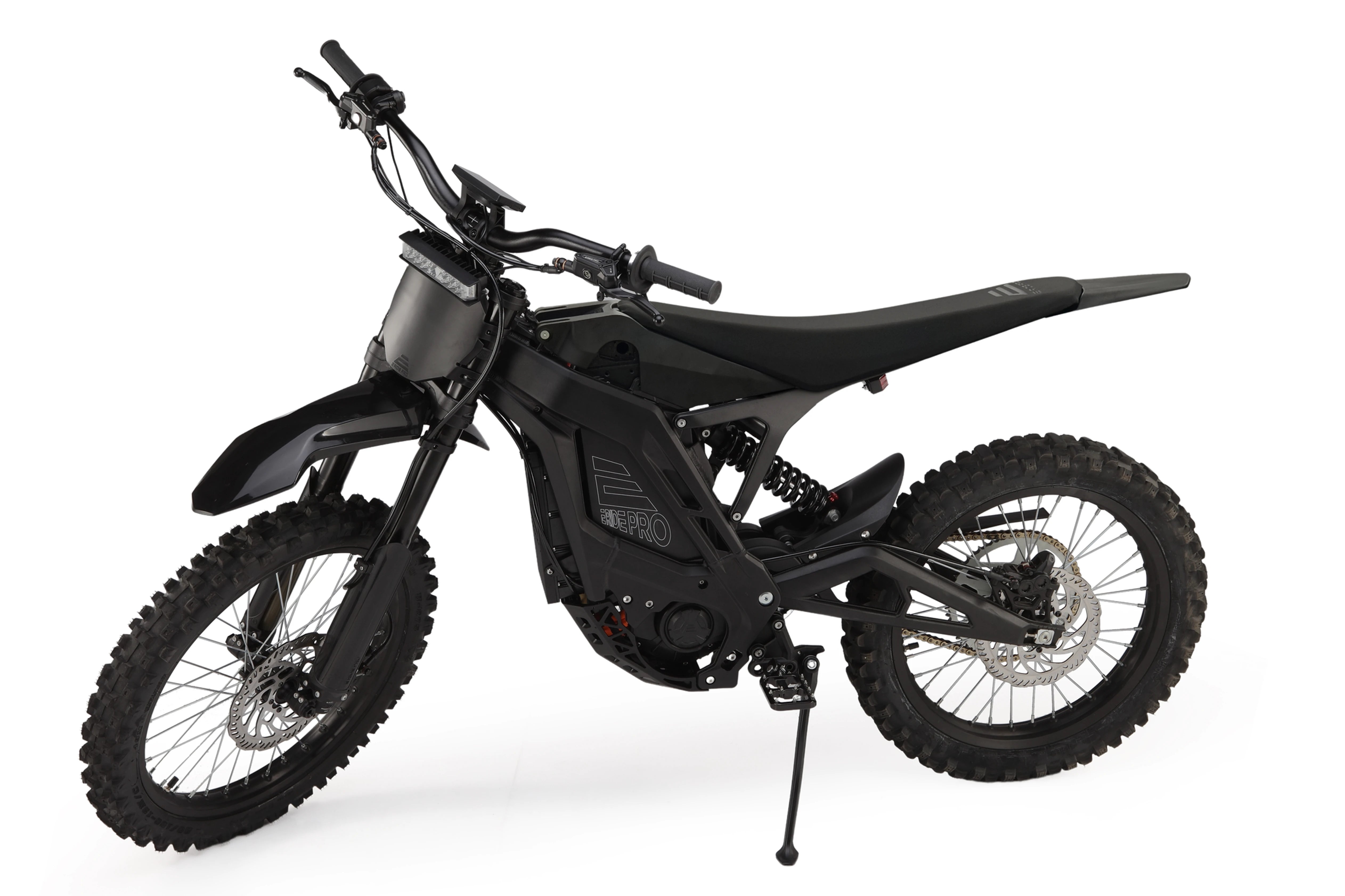
#1 — E-Ride Pro SR 25kW: Maximum Performance, Road-Legal
E-Ride Pro SR 25kW L1e / L3e / Off-road €6,990 (sale; regular €7,790) | 25 kW peak | 72V 50Ah (3.6 kWh) Samsung 50S | 83 kg | Max load: 137 kg | ✅ L1e / L3e
At €6,990, the E-Ride Pro SR is the strongest performance-per-euro argument in the entire vectorebike.com lineup. It is road-legal as L1e — meaning a German rider with a standard Class B driving licence, paying approximately €45–65/year for Versicherungskennzeichen, can legally ride 25 kW of peak power to work in Munich every morning. No TÜV. No road tax. No motorcycle licence required.
The SR's 25 kW comes through a 72V 50Ah Samsung 50S battery with active liquid cooling — a system that maintains performance consistency under sustained high-power use, not just for peak-power marketing. FastAce fully adjustable suspension front and rear. Full Bluetooth controller tuning via mobile app: power curves, throttle sensitivity, regen levels, speed limits — all programmable. In practical use, the 3.6 kWh battery can deliver strong road range in L1e use and meaningfully shorter range in faster or more aggressive off-road riding, depending on speed, rider weight, terrain, and temperature.
The honest caveat: 25 kW demands experience. The SR in Boost mode will lift the front wheel on full throttle from a standing start. Riders new to motorised two-wheelers should start with the SS 3.0 (position #3) and build into the SR's power over time. For experienced riders who know exactly what they want, the SR at €6,990 is extraordinary value.
Germany specifically: L1e version at €6,990 — Versicherungskennzeichen + Class B licence, operational from day one. L3e version for riders with motorcycle licences who want unrestricted road speeds. Both configurations available; hardware identical.
Best for: Experienced adults who want the highest available performance in a road-legal machine at this price; German commuters who want 25 kW on tap with a Versicherungskennzeichen and nothing else.
Full review: E-Ride Pro SR Review: Is the 25kW Motor Worth the Hype?
#2 — Talaria Komodo 32kW: Highest Power and Largest Battery in the Tier
Talaria Komodo 32kW L3e / Off-road ~€6,650 | 32 kW peak | 97.2V 45Ah (4.4 kWh) | ~98 kg | ✅ L3e / Off-road
The Talaria Komodo is the outlier in this guide — the highest peak power, the largest battery, and the only 97.2V platform in the €5,000–7,000 range. At 32 kW it produces approximately 43 hp with instant full-torque delivery. The 4.4 kWh battery is one of the largest in the current lineup and gives the Komodo unusually strong range potential for a high-power platform, with actual results depending heavily on speed, terrain, and riding style.
The Komodo is a completely new Talaria platform — not an upgrade of the Sting. Full-size motorcycle geometry: adult proportions, longer wheelbase, taller seat, competition-grade long-travel suspension sized for high-speed riding by adult-sized riders. Riders who found the Sting series compact are the target demographic.
The 97.2V voltage architecture deserves specific mention. At equivalent power output, a higher-voltage system requires less current — which means less resistive heat generation. The Komodo's thermal headroom at sustained high power is meaningfully better than a 72V machine producing similar peak numbers.
Germany specifically: L3e only — no L1e version of the Komodo exists. The 32 kW output and full-size platform sit inherently in L3e territory. Motorcycle licence required (A1, A2, A, or B196 Erweiterung). Full registration at the Zulassungsstelle with TÜV and Kfz-Steuer. For German riders with the appropriate licence, the Komodo L3e is the most powerful road-legal e-moto available at this price.
Best for: Experienced riders who have outgrown 72V platforms and want full-size motorcycle geometry; German riders with motorcycle licences who want maximum performance within the €7,000 budget.
#3 — E-Ride Pro SS 3.0 15.8kW: The Best All-Round Machine in the Tier
E-Ride Pro SS 3.0 15.8kW L1e / L3e / Off-road check current listing price | high-performance 72V platform | 72V 50Ah (3.6 kWh) | 75 kg | Max load: 137 kg | ✅ L1e / L3e
If a single model from this entire guide were to represent the vectorebike.com lineup at its most complete, it would be the SS 3.0. It delivers 15.8 kW — enough to be genuinely fast on trail and aggressive on technical sections — at 75 kg (8 kg lighter than the SR), with the same 3.6 kWh Samsung 50S battery as the flagship. Dual L1e/L3e support on identical hardware. The same FastAce suspension platform.
The SS 3.0 is the model that answers the question "what should I actually buy?" for the largest proportion of vectorebike.com customers. Not too powerful for an intermediate rider to manage. Not underpowered for an experienced trail rider to find engaging. Enough battery for a real commute and a real off-road session.
The commuter argument: SS 3.0 L1e in Munich → Versicherungskennzeichen (~€45–65/year), Class B licence, no TÜV, no road tax. Practical road range is strong enough for many daily commuting use cases, while the same platform still has enough performance for weekend trail riding. One machine, with far fewer compromises than most lower-tier options.
The power mode spectrum: Eco mode gives smooth, manageable power suitable for developing riders or urban traffic. Boost mode delivers the full 15.8 kW for trail and technical off-road. This programmable range makes the SS 3.0 a machine that grows with the rider rather than needing replacement when skills advance.
Best for: The widest range of buyers in this tier — German commuters, weekend trail riders, adults entering the high-performance e-moto segment, and anyone who wants one machine to do everything.
Full review: E-Ride Pro SS 3.0 Review: The Ultimate 15.8kW Hybrid
#4 — E-Ride Pro SS 2.0 12kW: Best Value 72V Road-Legal Machine
E-Ride Pro SS 2.0 12kW L1e / Off-road ~€5,700 | 12 kW peak | 72V 40Ah (2.9 kWh) Samsung | ~63 kg | Max load: 100 kg | ✅ L1e
The SS 2.0 is the most price-accessible 72V road-legal e-moto in the E-Ride Pro lineup, and the most popular model for German urban commuters who want 72V performance without the weight and cost of the SS 3.0 or SR.
At 63 kg it is the lightest E-Ride Pro in the 72V range — a measurable practical advantage in cities: tip-over recovery, carrying up stairs, storage in a compact urban garage, and slow-speed manoeuvring in traffic. The 12 kW peak delivers strong urban acceleration, and the 2.9 kWh battery covers 60–80 km at 45 km/h — sufficient for most German city commutes with a return margin. L1e only — no L3e version of the SS 2.0.
The SS 2.0 vs SS 3.0 decision: €750 separates these models. The SS 3.0 adds 3.7 kW of peak power, 0.7 kWh of battery capacity, and dual L1e/L3e certification. For riders who primarily commute and occasionally trail ride, the SS 2.0 is the more practical machine at a lower price. For riders who ride aggressively off-road regularly, the SS 3.0's extra power and battery justify the €750 difference.
Germany specifically: Versicherungskennzeichen only. Class B from age 18. Annual running cost from approximately €45–65 in insurance. No TÜV, no road tax. At ~€5,700 with these operating costs, the SS 2.0 is the strongest total-cost-of-ownership argument for a German adult commuter in the 72V tier.
Best for: Urban commuters in Germany who want 72V performance and L1e road legality at the lowest feasible price; adults who prioritise light weight and ease of handling over maximum power.
#5 — E-Ride Pro SE 10kW: Lightest 72V Road-Legal Platform
E-Ride Pro SE 10kW L1e / Off-road ~€5,400 | 10 kW peak | 72V 40Ah (2.9 kWh) Samsung | 63 kg | ✅ L1e
The E-Ride Pro SE holds a specific position in the lineup that no other model occupies: the lightest 72V machine, at the lowest price in the 72V E-Ride Pro range. At ~€5,400 with 63 kg and full L1e road certification, it is the entry point into the 72V E-Ride Pro ecosystem for riders who want the platform's performance character without the additional weight or cost of the SS 2.0 or SS 3.0.
The 72V 40Ah (2.9 kWh) battery delivers 60–80 km at 45 km/h — practical for German urban commuting. The 10 kW power output is meaningfully lower than the SS 2.0 (12 kW) and SS 3.0 (15.8 kW), but for riders coming from 60V platforms or pedal-assist e-bikes, it represents a substantial step up that does not require immediate adjustment to aggressive throttle delivery.
SE vs SS 2.0: ~€300 separates these models. The SS 2.0 adds 2 kW and costs marginally more. For riders who have ridden motorcycles before and want to grow into the power: start with the SS 2.0. For riders who want 72V characteristics with the most manageable power delivery: the SE is the correct starting point.
Best for: Riders transitioning from 60V platforms or non-motorised backgrounds; adults who want 72V performance with the softest power delivery in the E-Ride Pro range; German commuters who prioritise low weight and road legality at the entry-level 72V price.
Full review: E-Ride Pro SE Review
#6 — Vector Vortex 10kW: Maximum Range and German-Built Durability
Vector Vortex 10kW Off-road ~€5,400 | 10 kW+ peak | 72V 52Ah (3.8 kWh) Panasonic | 69 kg | Max load: 150 kg | ❌ Off-road only
The Vector Vortex is the only model in this guide without road certification, and the model with the highest maximum rider load at 150 kg — the most permissive load rating in the entire vectorebike.com lineup. It is designed by vectorebike.com in Munich, manufactured to their specifications, and serviced by the same team that sells it.
The mid-drive motor mounted directly on the swingarm is the Vortex's defining mechanical feature. Unlike hub-drive systems where the motor is at the rear axle, the Vortex's centralised motor placement keeps weight distribution neutral regardless of how deeply the suspension compresses. The result is handling behaviour that experienced riders consistently describe as closer to a petrol dirt bike than any hub-drive alternative.
The 3.8 kWh battery is one of the biggest in this price band. vectorebike.com presents the Vortex with a 200+ km manufacturer claim at 35 km/h, while real off-road range will vary substantially with rider weight, terrain, and speed. For off-road riders who measure their sessions in hours rather than laps, the Vortex addresses range anxiety more effectively than any other model in this tier.
The oversized steel frame accommodates custom battery packs up to 5.5 kWh for clients who want maximum range. The Kelly 300A controller can be configured via sprocket selection for maximum torque vs maximum top speed — mechanical tunability absent from competing platforms.
Germany specifically: Off-road only. Legal riding requires private land with owner permission, a dedicated MX facility, or other clearly permitted off-road access. For a full explanation of German off-road riding law, see Electric Dirt Bike vs Electric Off-Road Bike in Germany.
Best for: Heavier adult riders (80–120+ kg); off-road riders who prioritise range and durability over road legality; private-land users with legal riding access; long-term ownership buyers who want maximum upgradeability.
Full review: Vector Vortex Review: Analyzing the 10kW, 200km Range Electric Powerhouse
#7 — Talaria MX5 Pro 13kW: The Agile Trail Specialist
Talaria MX5 Pro 13kW L1e / Off-road €5,190 | 13 kW peak | compact Talaria battery platform | 76 kg | ✅ L1e / Off-road
At €5,190, the Talaria MX5 Pro sits at the entry end of this tier — but it earns its place on performance character rather than compromise. 13 kW through Talaria's proprietary gearbox and primary chain drive produces power delivery that experienced trail riders consistently prefer over direct hub-drive alternatives for technical terrain. The gearbox-mediated output feels more progressive and intuitive; less like a switch being thrown, more like a motor finding its stride.
The MX5 Pro's battery platform is the outlier in this otherwise 72V-dominated guide, and that comes with an honest trade-off: lighter, more agile feel, but less range headroom than the larger-battery models above it. In real use, it suits focused trail sessions better than long mixed road-and-trail days. This is adequate for focused trail sessions; less so for riders planning all-day rides or mixing significant road transit with off-road use.
What the 60V platform provides in return: lighter weight (76 kg vs 83 kg for the SR), the Talaria gearbox's distinctive power character, and the lowest price point in this €5,000–7,000 guide with L1e certification.
Germany specifically: L1e version available — Versicherungskennzeichen, Class B from age 18. At €5,190 it is the most affordable model in this guide with L1e road certification. For German riders who primarily ride trails and want a lightweight, agile machine with legal road access for transit, the MX5 Pro is a strong choice within its range limitations.
Best for: Trail riders who prioritise agility and the Talaria gearbox character over maximum range; German riders who want the most affordable L1e machine in the mid-performance tier.
Full review: Talaria Sting MX5 Pro Review: The Benchmark for Lightweight E-Moto Agility
How to Choose: Decision Framework by Use Case
The seven models in this guide serve genuinely different riders. Three questions narrow the field quickly:
Do you need road access in Germany? If yes, the Vector Vortex is immediately excluded. The remaining six are all road-legal in at least one configuration.
What licence do you currently hold? Class B only → L1e models (SR L1e, SS 3.0 L1e, SS 2.0 L1e, SE L1e, MX5 Pro L1e). Motorcycle licence (or willing to get B196 Erweiterung) → add the SR L3e, SS 3.0 L3e, and Komodo L3e to your options.
What is the primary use — commuting, trail riding, or both?
|
Primary use |
Recommended model |
Why |
|
German daily commuter, Class B |
Lightest 72V L1e, lowest running cost |
|
|
Commute + aggressive trail, one bike |
Best dual-purpose balance |
|
|
Max performance, road-legal |
25 kW, L1e or L3e |
|
|
Max power, motorcycle licence |
32 kW, 4.4 kWh, L3e |
|
|
Off-road only, max range |
3.8 kWh, 150 kg load, mid-drive |
|
|
Trail agility, budget conscious |
Gearbox character, lowest price here |
|
|
72V entry, lightest platform |
Entry 72V, most manageable power |
Complete Comparison Table
|
Model |
Price |
Power |
Battery |
Weight |
Road Legal |
Load |
|
€6,990 |
25 kW |
72V 50Ah / 3.6 kWh |
83 kg |
✅ L1e/L3e |
137 kg |
|
|
~€6,650 |
32 kW |
97.2V 45Ah / 4.4 kWh |
~98 kg |
✅ L3e |
high |
|
|
~€6,450 |
15.8 kW |
72V 50Ah / 3.6 kWh |
75 kg |
✅ L1e/L3e |
137 kg |
|
|
~€5,700 |
12 kW |
72V 40Ah / 2.9 kWh |
63 kg |
✅ L1e |
100 kg |
|
|
~€5,400 |
10 kW |
72V 40Ah / 2.9 kWh |
63 kg |
✅ L1e |
100 kg |
|
|
~€5,400 |
10 kW+ |
72V 52Ah / 3.8 kWh |
69 kg |
❌ Off-road |
150 kg |
|
|
€5,190 |
13 kW |
60V 40Ah / 2.4 kWh |
76 kg |
✅ L1e |
100 kg |
What Buying from an Authorised German Dealer Means at This Price
At €5,000–7,000, the question of where you buy matters more than at lower price points. The machines in this guide are real motorcycles with electrical complexity — not toys with limited consequences if something goes wrong.
Purchasing through vectorebike.com as the official EU dealer for E-Ride Pro and Talaria, and manufacturer of Vector, means: 27-month warranty (24 months manufacturer + 3 months dealer), 2 sets of brake pads and extra tyres included, Munich-based service centre with 11+ years experience on these specific platforms, genuine spare parts (not generic replacements), and after-warranty support.
For L1e models in Germany, this also means purchasing a machine with verified, genuine EU homologation documentation. Grey-market imports of "L1e certified" e-motos sometimes come with documentation that does not withstand scrutiny from a German insurer or road authority. Purchasing from vectorebike.com as the authorised dealer eliminates this risk.
For more on finding the right model and purchasing safely in Germany, see Where to Buy E-Ride Pro in Germany.
All models in this guide are in stock at vectorebike.com with free delivery to Germany (3–5 business days) and across the EU (5–10 business days). Every purchase includes a 27-month warranty (24+3), 2 sets of brake pads, and extra tyres. Test rides available for all models — book here.
Browse the full lineup →
FAQ
What is the best electric dirt bike between €5,000 and €7,000?
For the largest number of buyers, the E-Ride Pro SS 3.0 is the strongest single answer for the widest range of buyers. It combines a 3.6 kWh battery, dual L1e/L3e availability, and a relatively manageable 75 kg chassis in one platform. For riders who specifically want maximum peak power, the E-Ride Pro SR at €6,990 delivers 25 kW with the same battery and L1e road legality. For maximum power + largest battery with a motorcycle licence, the Talaria Komodo at ~€6,650 with 32 kW and 4.4 kWh.
Which models in this range can I ride with a car licence in Germany?
All L1e certified models: E-Ride Pro SR L1e, SS 3.0 L1e, SS 2.0 L1e, SE L1e, and Talaria MX5 Pro L1e. All require only a Versicherungskennzeichen (~€45–65/year) and a standard Class B (car) driving licence. No TÜV, no road tax. The Talaria Komodo requires a motorcycle licence in L3e configuration. The Vector Vortex has no road certification.
Is the E-Ride Pro SS 3.0 worth the extra €750 over the SS 2.0?
For riders who use the bike predominantly for off-road riding: yes. The SS 3.0 adds 3.7 kW, 0.7 kWh, and dual L1e/L3e certification. The extra power is noticeable on trail; the extra battery extends range by approximately 15–20 km. For riders who primarily commute and rarely go off-road aggressively: the SS 2.0 is sufficient and €750 cheaper. See the E-Ride Pro Buyer's Guide for a full comparison.
Can the Vector Vortex be ridden on German roads?
No. The Vector Vortex has no L1e or L3e certification and cannot be legally ridden on German public roads, including forest paths. It requires private land with owner permission, a dedicated MX facility, or other legally permitted off-road access. If road access is required, choose one of the L1e models in this guide.
What affects range most in this price tier?
Speed is the dominant variable. Road range is usually much higher in L1e-style riding than in aggressive off-road use, and battery size only tells part of the story: rider weight, terrain, temperature, tyre choice, and throttle behaviour all matter. As a rule, the 3.6 kWh models sit above the 2.9 kWh models for practical road range, while aggressive off-road riding shortens the gap because riding style becomes more dominant. Full range analysis: Understanding Electric Dirt Bike Range.


