

Author: Artur Ragulskyi | CEO & Founder
Reading time: ~11 minutes
Finding the right electric dirt bike when you have a lower inseam is not simply a matter of checking seat heights and picking the lowest number. That is the most common mistake — and it leads to buying the wrong bike.
From 11 years of building, tuning, and selling electric motorcycles across the EU, the same pattern comes up again and again: riders focus on seat height in isolation, overlook total weight and cockpit geometry, and end up with a machine that technically "fits" but is frustrating to ride. This guide covers everything that actually matters — seat height, bike weight, power delivery, ergonomics, and the specific models from the Vectorebike lineup that work best for riders in the 160–175 cm range and below.
Quick Answer: The Right Model by Rider Profile
|
Model |
Seat Height |
Weight |
Peak Power |
Best For |
|
~805 mm |
55 kg |
5 kW |
Beginners, first e-moto, urban/trail crossover |
|
|
685 mm |
49 kg |
8 kW |
Very compact riders, pit bike, technical terrain |
|
|
840 mm |
76 kg |
13 kW |
Intermediate trail riders, gearbox smooth delivery |
|
|
~840 mm |
~84 kg |
22.5 kW |
Experienced riders wanting 98V performance |
|
|
~830 mm |
76 kg |
18 kW |
Advanced riders, lowest seat in 72V high-power tier |
|
|
~830 mm |
83 kg |
25 kW |
Experienced riders, maximum performance |
All models ship free across the EU (including Switzerland, Germany, and Austria) with a 27-month warranty (24 months manufacturer + 3 months dealer), and a spare tyre set included.
Why Seat Height Alone Doesn't Tell the Full Story
Most buying guides reduce fit to one number. In practice, fit is a system — and seat height is only one part of it.
The five factors that determine real-world fit:
1. Seat height — the most obvious metric. A useful rule: you should be able to place at least one foot flat on the ground at a complete stop, or tiptoe confidently with both feet. For most riders, this corresponds to a seat height roughly 25–50 mm below your inseam measurement. But this is a starting point, not a ceiling.
2. Bike weight — arguably more important than seat height in slow-speed situations. A 55 kg bike and a 76 kg bike can share the same seat height, but the lighter bike is dramatically easier to manage in the moments that challenge new or compact riders most: catching a lean, recovering from a tip-over, holding balance on a technical section.
3. Cockpit reach — the distance from the seat to the handlebars. A bike can have an acceptable seat height but still feel wrong if the rider has to stretch to reach the bars, or conversely if the cockpit is cramped. This is one of the most overlooked dimensions in spec comparisons.
4. Power delivery character — peak power numbers matter less than how that power arrives. Electric motors deliver full torque instantly — there is no clutch to feather, no RPM to build. On a bike that fits imperfectly, abrupt or high-intensity torque delivery amplifies every fit problem. Smooth, progressive delivery is directly more manageable.
5. Suspension setup — the most commonly overlooked variable. A bike with suspension set too stiff for a lighter rider sits several centimetres higher than necessary. Adjusting preload to match actual rider weight in full gear can reduce effective seat height by 10–20 mm without any mechanical modification. This alone resolves many "it doesn't fit" conclusions before they reach the point of purchase.
Understanding Suspension Sag: A Quick Setup Guide
Before concluding that any bike is too tall for you, check whether the suspension is correctly set for your weight.
With a rider in full gear — helmet, boots, backpack, typical riding load — the suspension should compress by approximately 25–30% of its total travel under static load. This is called "sag."
On a fork with 200 mm of travel, correct sag is approximately 50 mm of compression under rider weight. On a rear shock with 85 mm stroke, correct sag is roughly 20–25 mm.
If the bike only sags by 10–15 mm, the suspension is set for a much heavier rider. The effective seat height is therefore several centimetres higher than necessary for you. Adjusting preload is a straightforward process on all models in the Vectorebike lineup and should be the first step before any conclusions about fit.
The 5 Best Electric Dirt Bikes for Riders with a Lower Inseam
1. Talaria X3 Pro (XXX) — Best Fit and Lightest Weight in the Lineup
Seat height: ~805 mm | Weight: 55 kg | Power: 5 kW | Battery: 60V 40Ah
The Talaria X3 Pro is the clearest starting point for riders who prioritise ergonomic fit. At 805 mm, it has the lowest published seat height in the Vectorebike range. At 55 kg, it is the lightest full-capability electric dirt bike available through the lineup — meaningfully lighter than any 72V platform.
The combination of these two factors creates a riding experience that is qualitatively different from heavier alternatives. When tip-overs happen — and they happen to everyone, especially in the first season — a 55 kg bike is recoverable solo in almost any situation. On a 76 kg bike, recovery on a muddy slope alone is a genuine physical challenge.
The X3 Pro is not a beginner toy. It uses an IPM motor of the same type as the higher-end Sting models, tuned to 5 kW peak with a 75 km/h unlocked top speed. The power delivery is smooth and progressive, which makes throttle modulation natural for riders still developing off-road technique.
For German buyers: the X3 Pro is available in an L1e certified configuration. This means it can be ridden legally on public roads with a standard Class B driving licence (Führerschein Klasse B) — no additional motorcycle licence required. Insurance is handled through an annual Versicherungskennzeichen, which typically costs €40–120 per year. This makes the X3 Pro one of the most practical options for German riders who want to ride from home to the trail legally without additional paperwork or qualifications.
The honest trade-off: 5 kW and 60V place this bike in the entry/intermediate tier. Riders who progress quickly will eventually want more power. The natural step-up is the Talaria MX5 Pro.
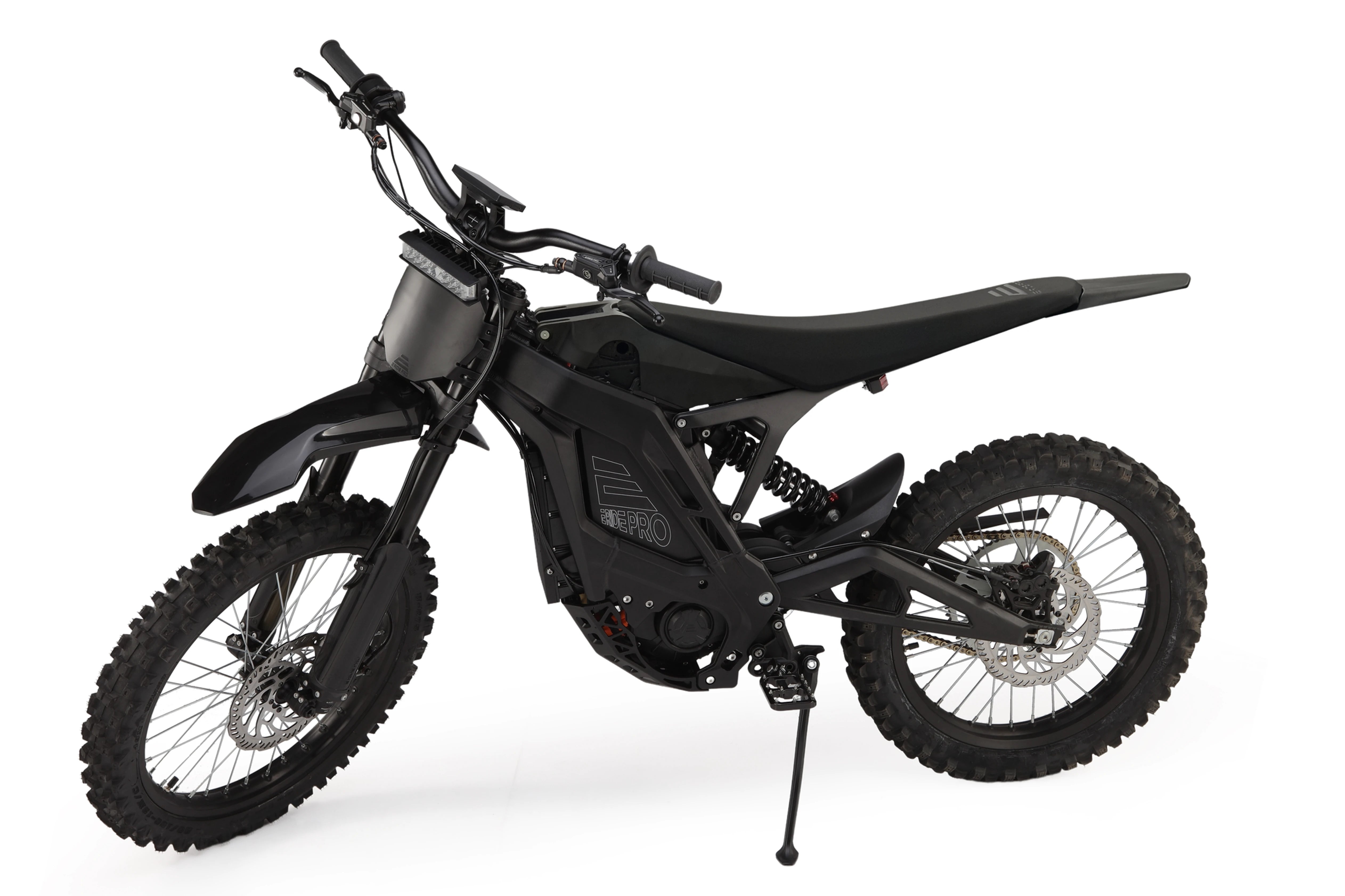
2. E Ride Pro Mini — Best for the Most Compact Fit and Technical Terrain
Seat height: 685 mm | Weight: 49 kg | Battery: 72V 30Ah
The E Ride Pro Mini occupies a different category than the other bikes in this guide — and for specific riders, it is the right answer.
With its smaller wheels (16" front, 14" rear), compact frame geometry, and weight approximately 6 kg lighter than the Talaria X3 Pro, the Mini creates a riding experience that is physically accessible in a way that no full-size platform can match. Riders who struggle to flat-foot a standard Talaria or Surron will feel the difference immediately.
The Mini is not a children's bike in disguise. It shares the robust DNA of the E Ride Pro line — hydraulic fork, genuine hydraulic disc brakes, and a rear shock capable of handling jumps and roots. But its compact proportions make it the right tool for riders who find full-size bikes physically demanding in slow-speed technical situations.
Best suited for: compact adult riders who prioritise manageability above all else; riders learning technical off-road skills on tight terrain; use cases where weight and handling precision matter more than top speed.
The honest trade-off: smaller wheels and a compact frame limit high-speed stability compared to full-size platforms. This is not the right bike for open trails at speed — it excels on tight, technical terrain.
3. Talaria Sting MX5 Pro — Best Performance Balance for Fit-Conscious Riders
Seat height: 840 mm | Weight: 76 kg | Power: 13 kW | Battery: 72V 40Ah (2,880 Wh)
The Talaria MX5 Pro is the step up into genuine 72V performance territory with a seat height that remains accessible. At 840 mm, it sits in the tiptoe zone for riders under approximately 165 cm — manageable with practice, and significantly more forgiving than larger alternatives at similar power.
What distinguishes the MX5 Pro from other 13 kW options is Talaria's sealed gearbox drivetrain. The gearbox produces a smooth, progressive power curve — consistent feedback from the riding community describes it as the most natural-feeling throttle response in the lightweight e-moto segment. For riders who are simultaneously managing fit challenges, this smoothness is directly relevant: it removes the abrupt torque spikes that make oversized bikes feel unpredictable.
Three riding modes (Eco / Sport / Hyper) allow genuine power reduction in each mode, not just a token setting. Running Eco mode at the beginning of each session significantly changes the character of the bike while skills develop.
For German buyers: The MX5 Pro is a pure off-road platform without L1e certification. In Germany, this means it may only be ridden on private land or designated off-road areas — not on public roads, paths, or forest roads accessible to vehicles. Riding without Straßenzulassung on any publicly accessible route is a criminal offence in Germany and voids all insurance coverage. If you need road access to reach your riding area, consider the E Ride Pro SS 2.0 or SS 3.0 in L1e configuration instead.
The honest trade-off: 840 mm requires confident tiptoe for riders under 165 cm. The 76 kg weight is manageable for most adults, but recovery from tip-overs requires more effort than on the X3 Pro. Progression in fit demands here.
4. Altis Sigma 22.5 kW — Highest-Voltage Option with Accessible Seat Height
Seat height: ~840 mm | Weight: ~84 kg | Power: 22.5 kW | Battery: 98V 35Ah (3,402 Wh, Samsung 50S)
The Altis Sigma brings a different architecture to this conversation: a 98V system rather than the 72V found in E Ride Pro and Talaria platforms. Higher voltage means lower current for equivalent power output, which results in less motor heat under sustained load and a smoother top-end performance curve.
At approximately 840 mm, the Sigma shares seat height with the MX5 Pro and falls within the accessible range for riders with a lower inseam who have developed off-road experience. The 22.5 kW peak output and 600 Nm of torque place it firmly in the advanced tier — this is not a bike for riders still building confidence.
The Sigma comes in two wheel configurations: F19"/R19" for trail and mixed-terrain use, and F19"/R16" (Sigma MX) for motocross-oriented riding. The R16" rear configuration sits marginally lower, which can improve reach for riders at the lower end of the accessible seat height range.
For experienced riders: the 5-level regenerative braking and TFT display with NFC-enabled tuning give fine-grained control over power delivery that more experienced riders will genuinely use. The adjustable air-spring suspension allows proper sag adjustment for lighter riders without replacement components.
The honest trade-off: at 84 kg, the Sigma is among the heavier bikes in this guide. This weight advantage disappears in slow-speed technical situations and tip-over recovery. This bike is best suited for experienced riders who are specifically looking for 98V performance in an accessible seat height, not for riders still developing off-road fundamentals.
5. E Ride Pro SS 3.0 — Lowest Seat Height in the High-Performance 72V Tier
Seat height: ~830 mm | Weight: 76 kg | Power: 18 kW | Battery: 72V 50Ah (3,600 Wh)
The E Ride Pro SS 3.0 offers one of the lowest published seat heights in the high-performance 72V segment — approximately 830 mm — combined with 18 kW of peak power, a 3,600 Wh Samsung battery, and Bluetooth-enabled tuning via smartphone.
This combination is specifically well-suited to riders with a lower inseam who do not want to sacrifice performance. The Bluetooth app allows genuine power reduction in each mode — not a token Eco setting, but a configurable reduction to 30–40% of output that changes the character of the bike substantially. Building from lower to higher output as skills develop is exactly the right approach on a machine of this power level.
Available in L1e, L3e, and off-road configurations, the SS 3.0 is one of the most versatile models in the lineup. The L1e version provides full street legality across the EU at 45 km/h; L3e removes the speed restriction for riders with A1/A2/A motorcycle licences.
For German buyers: the L1e version is the most practical entry point for most riders. It requires only a Class B driving licence, an annual Versicherungskennzeichen (€40–120/year), and a motorcycle helmet (Helmpflicht). Full details on German licence requirements for L1e and L3e models are covered in Vectorebike's German licence guide.
The honest trade-off: 18 kW in Sport or Race mode is a genuinely powerful machine. This bike is appropriate for riders with established off-road experience who are deliberately managing their progression. Bluetooth tuning is a genuine tool here — use it.
Bonus: E Ride Pro SR — Maximum Performance, Same Accessible Seat Height
Seat height: ~830 mm | Weight: 83 kg | Power: 25 kW | Battery: 72V 50Ah (3,600 Wh)
The E Ride Pro SR deserves mention because it shares the ~830 mm seat height of the SS 3.0 while delivering 25 kW of peak power — making it, in principle, the most powerful e-moto available with an accessible seat height. For an experienced rider with a lower inseam who wants top-tier performance without the seat height penalty of full-size MX platforms, the SR is a realistic option.
The caveat is honest and important: the SR in Race mode will wheelie at any speed. This bike requires experienced hands and deliberate power management via the Bluetooth tuning app. It is not appropriate for riders still developing technique, regardless of how well it physically fits.
View E Ride Pro SR → | Read the full E Ride Pro Buyer's Guide →
Weight Comparison: What the Numbers Actually Feel Like
The weight differences between models are not theoretical. They translate directly into specific riding situations.
|
Model |
Weight |
Where you feel the difference |
|
E Ride Pro Mini |
~35 kg |
Maximum manageability in every situation |
|
Talaria X3 Pro |
55 kg |
Very easy solo tip-over recovery on any terrain |
|
E Ride Pro SS 3.0 / MX5 Pro |
76 kg |
Manageable for most adults; demanding solo on slopes |
|
E Ride Pro SR / Altis Sigma |
83–84 kg |
Noticeable effort in recovery situations |
You feel the difference in three specific moments, not at trail speed:
Recovering from a tip-over — lifting 76 kg alone on a muddy or angled surface is a different physical challenge than lifting 55 kg. For riders who are lighter in build or working alone in remote areas, this is a meaningful safety and comfort consideration.
Slow-speed technical sections — holding the bike stable with one foot down while navigating obstacles requires more energy on heavier platforms. The lighter the bike, the more the rider can focus on technique rather than fighting weight.
Transport — loading a bike into a van or onto a ramp matters when you ride solo. The 21 kg difference between the X3 Pro and the SS 3.0 is obvious at the end of a day when arms are tired.
The key principle: start on the lightest platform that meets your performance needs. Moving up in weight and power is a natural, satisfying progression. Moving down is more expensive and less satisfying.
Rider Profiles: Which Bike for Which Rider
|
Rider Profile |
Recommended Model |
Primary Reason |
|
Complete beginner, first e-moto |
Lowest seat (805 mm) + lightest weight (55 kg) |
|
|
Very compact rider, maximum manageability |
Smallest frame, lightest weight, razor-sharp handling |
|
|
Intermediate, technical trails |
840 mm seat, gearbox smooth delivery, 13 kW |
|
|
Advanced, trail + street (L1e/L3e) |
~830 mm seat, 18 kW, Bluetooth tuning |
|
|
Experienced, 98V performance |
840 mm, 22.5 kW, 98V thermal efficiency |
|
|
Experienced, maximum 72V performance |
~830 mm despite 25 kW; requires experience |
|
|
Beginner wanting street legality (L1e) |
L1e certification + accessible seat height |
German Buyers: Legal Classification at a Glance
This section is particularly relevant for buyers in Germany, Austria, and Switzerland, where road classification rules directly affect which bikes can be ridden where and with which licence.
L1e (Moped / Kleinkraftrad):
- Speed limited to 45 km/h on public roads
- Requires: Class AM or Class B driving licence (standard car licence)
- Requires: annual Versicherungskennzeichen (€40–120/year), certified motorcycle helmet
- No TÜV inspection, no road tax registration plate
-
Available models: Talaria X3 Pro L1e, E Ride Pro SS 2.0 L1e, E Ride Pro SS 3.0 L1e, E Ride Pro SR L1e
L3e (Light motorcycle / Leichtkraftrad or Kraftrad):
- Not software-limited on public roads
- Requires: A1 (up to 11 kW), A2 (up to 35 kW), or A licence; or B196 for riders with B licence for 5+ years aged 25+
- Requires: full registration, periodic inspection (HU/TÜV), road tax, and higher insurance premium
- Available models: E Ride Pro SS 3.0 L3e, E Ride Pro SR L3e, Talaria Komodo L3e
Off-road only (no Straßenzulassung):
- May only be ridden on private property or closed off-road areas with owner permission
- Riding on any publicly accessible road, path, or forest track is illegal and uninsured in Germany
- Available models: Talaria Sting MX5 Pro, Vector Vortex, Vector Tide, off-road variants of E Ride Pro
Important for German buyers: The L1e and L3e versions of models like the E Ride Pro SS are technically identical hardware — same motor, battery, controller, and frame. The difference is software and documentation. Unlocking an L1e bike to L3e speeds without updating registration and insurance is a criminal offence in Germany. Vectorebike's team in Germany handles all homologation documentation and can advise on the correct registration process.
What to Look For: Features That Matter Before You Buy
When evaluating any model, these factors matter most — in roughly this order:
1. Seat height under 840 mm — the practical threshold at which most adults up to approximately 170 cm can achieve confident footing. Above this, tiptoe technique is required, which is learnable but adds cognitive load on technical terrain.
2. Suspension adjustability — check whether front forks allow preload adjustment and whether the rear shock has adjustable preload. A correctly set suspension for your actual weight can reduce effective seat height by 10–20 mm.
3. Genuine power mode reduction — look for bikes where Eco mode represents a real power reduction, not just a token adjustment. E Ride Pro models with Bluetooth tuning allow configuration to 30–40% of full output, which meaningfully changes the riding character.
4. Bike weight relative to rider weight — for riders 60 kg and below, the 55 kg Talaria X3 Pro or ~35 kg E Ride Pro Mini deliver a fundamentally different handling experience than 76 kg platforms.
5. Handlebar adjustability — a bike with the right seat height can still feel wrong if the bars require stretching. E Ride Pro models include a direct stem mount that raises handlebar height, improving reach for many riders.
6. Test rides — Vectorebike offers test rides for all models. Seat height measurements describe a static number; how a bike feels at low speed and during slow-speed balance is something only riding reveals. Book a test ride →
Common Mistakes to Avoid
Buying for the spec sheet instead of fit. A 25 kW bike is impressive on paper. It is also harder to manage when you cannot reach the ground confidently at a stop. Impressive power does not compensate for poor ergonomic fit — it amplifies the consequences of it.
Treating seat height as the only relevant measurement. A 55 kg bike at 840 mm seat height can be more manageable than a 76 kg bike at 820 mm, because the lighter bike is more forgiving in every slow-speed and tip-over situation.
Skipping suspension adjustment. Many riders try a bike, find the seat is marginally high, and conclude the model is wrong for them. Before that conclusion, ask about preload adjustment. A 10–15 mm reduction through correct setup changes the accessible range significantly.
Skipping the learning stage to save on future upgrade costs. "I'll buy the powerful bike now so I don't need to buy twice" is a common rationale. The problem is that riding a 76 kg, 18 kW bike without the technique to manage it does not accelerate learning — it makes every ride more stressful and less educational. The Talaria X3 Pro is not a compromise; it is a genuinely capable machine that builds exactly the skills you will use on more powerful platforms.
Final Verdict
The right electric dirt bike for a rider with a lower inseam is the one where physical fit enables confident, safe, and enjoyable riding — not the one with the most impressive spec sheet.
New to electric dirt bikes: start with the Talaria X3 Pro (XXX). The 805 mm seat height, 55 kg weight, and progressive 5 kW power make it the most accessible and forgiving bike in the lineup. Available in L1e for full EU road legality with a Class B driving licence.
Intermediate, want real 72V performance: the Talaria Sting MX5 Pro at 840 mm offers the best combination of accessible seat height and genuine trail performance through its gearbox drivetrain.
Advanced, want maximum performance without a high seat: the E Ride Pro SS 3.0 at ~830 mm delivers 18 kW with Bluetooth-configurable power — the lowest seat height in the high-performance 72V tier. For the maximum output step, the E Ride Pro SR at 25 kW shares the same seat height.
Most compact fit, maximum manageability: the E Ride Pro Mini at 49 kg for riders who prioritise handling precision and easy recovery above all else.
Browse the full lineup → | Book a test ride → | Read the E Ride Pro Buyer's Guide →
FAQ
What is the best electric dirt bike for riders with a lower inseam?
For most riders prioritising fit and accessibility, the Talaria X3 Pro (XXX) is the strongest starting point: 805 mm seat height, 55 kg weight, and smooth progressive 5 kW power delivery. Riders with off-road experience who want more performance should look at the Talaria MX5 Pro (840 mm, 13 kW) or E Ride Pro SS 3.0 (~830 mm, 18 kW).
Is seat height the most important factor?
It is the most visible factor, but not the only one. Bike weight matters as much or more in slow-speed control and tip-over recovery. A 55 kg bike that requires slight tiptoe is often more manageable than a 76 kg bike with the same seat height. Suspension setup, handlebar reach, and power delivery character all contribute to real-world fit. Always evaluate seat height and weight together.
Are lighter electric dirt bikes easier for beginners?
Yes, consistently. A lighter bike requires less physical effort in the situations where beginners struggle most: slow-speed balance, tip-over recovery, and tight technical sections. The Talaria X3 Pro at 55 kg and E Ride Pro Mini at ~35 kg are significantly more forgiving than any 76+ kg alternative at equivalent seat heights.
Can a rider with a lower inseam handle a full-size electric dirt bike?
With experience and correct suspension setup, yes. The E Ride Pro SR at 25 kW and ~830 mm seat height is a realistic option for an experienced adult rider who uses the Bluetooth tuning to manage power carefully during the first months of ownership. But for riders still developing off-road technique, starting on a lighter and lower platform builds confidence and skill faster.
Which is more important for a compact rider: lower seat height or less weight?
Less weight, until skill level justifies more power. This is consistent guidance from experienced instructors across the e-moto community. A 55 kg bike with 5 kW teaches throttle control faster than a 76 kg bike with 18 kW does. Once the fundamentals are solid, adding power within the same weight class is the right progression.
What licence do I need in Germany for these bikes?
For L1e certified models (Talaria X3 Pro L1e, E Ride Pro SS 2.0/3.0 L1e, E Ride Pro SR L1e): your standard Class B car licence (Führerschein Klasse B) is sufficient. No motorcycle licence extension needed. For L3e models: A1 (for bikes up to 11 kW), A2 (up to 35 kW), or the B196 extension (for B licence holders aged 25+ with 5 years of B licence). Off-road-only models may not be ridden on any publicly accessible road or path in Germany. Full details on German licence requirements
How do I know if a bike fits me properly?
Three checks: (1) Sit on the bike in riding position — can you place at least one foot flat on the ground, or comfortably tiptoe with both feet? (2) Stand on the footpegs with knees slightly bent — this is the standard off-road riding position. Does it feel natural? (3) Grip the handlebars in riding position — are your arms slightly bent, not fully extended? If any of these feel significantly off, ask about suspension preload adjustment before concluding the model is wrong. Vectorebike offers test rides for all models — this is worth taking advantage of before purchase.