



Not every electric dirt bike is built with the same rider in mind. If standard seat heights leave you tiptoeing or struggling to reach the ground confidently, you're not alone — and the right bike genuinely exists in the current lineup. This guide is for riders who prioritize ergonomic fit alongside performance.
Quick Answer
Best electric dirt bikes for riders with a lower inseam — from the vectorebike.com lineup:
|
Model |
Seat Height |
Weight |
Peak Power |
Best For |
|
~805 mm (31.7 in.) |
55 kg (121 lbs) |
5 kW |
Beginners, urban/trail crossover |
|
|
840 mm (33.1 in.) |
76 kg (167 lbs) |
13 kW |
Intermediate trail riders |
|
|
~830 mm (32.7 in.) |
76 kg (167 lbs) |
18 kW |
Advanced riders wanting power + low seat |
|
|
~830 mm (32.7 in.) |
83 kg (183 lbs) |
25 kW |
Experienced riders, maximum performance |
The short version: If you want the most accessible seat height and the lightest bike in our range, the Talaria X3 Pro is the clear starting point at just 55 kg and ~805 mm seat height. For riders who want genuine high performance without giving up on reach, the E-Ride Pro SS 3.0 at ~830 mm delivers 18 kW alongside one of the lowest seat heights in the 72V tier.
Why Fit Matters Just as Much as Power
Most electric dirt bike reviews focus on motor specs, battery range, and top speed. Those numbers matter — but for riders with a lower inseam, a shorter torso, or a lighter build, the spec that determines whether a ride is enjoyable or exhausting is often none of those.
It's seat height.
When a bike fits well, you can place your foot down confidently at a stop, manage the bike's weight without fighting it, and focus your attention on the trail rather than on staying balanced. When it doesn't fit, everything becomes harder — stops feel tense, technical sections feel risky, and tip-overs are more physically demanding to recover from.
This matters even more with electric dirt bikes for a specific reason: electric motors deliver full torque instantly. There's no clutch to feather, no RPM to build. The moment you roll the throttle, the power arrives. On a bike that's slightly too large for you, that instant torque is harder to modulate — which makes an oversized bike feel less controlled than the same power output would on a properly fitting platform.
The good news is that several models in the vectorebike.com lineup have seat heights that work well for riders between approximately 160–175 cm (5'3"–5'9"), and with smart spec choices, even riders below this range can find a capable machine.
What Actually Makes an Electric Dirt Bike Better for a Rider with a Lower Inseam?
Four specifications matter most. Knowing them helps you evaluate any bike — not just the ones in this guide.
Seat Height
The most direct measurement. A practical benchmark: you should be able to place at least one foot flat on the ground at a complete stop, or comfortably tiptoe with both feet simultaneously. For most adults, this corresponds to a seat height roughly 25–50 mm below your inseam measurement.
Practical benchmarks by seat height:
- Under 820 mm: Flat-foot accessible for riders approximately 160 cm and taller
- 820–840 mm: Comfortable flat-foot or easy tiptoe for riders approximately 163–170 cm
- 840–860 mm: Tiptoe territory for riders under 167 cm; manageable with practice and confidence
- Above 870 mm: Requires confident tiptoe technique or a rider over approximately 172 cm
Bike Weight
Weight determines how demanding the bike is in slow-speed situations, recovery from tip-overs, and any moment when you're manually holding or guiding it. A 55 kg bike and a 76 kg bike may both have the same seat height, but the lighter bike will be dramatically easier to manage when it falls over on a technical section.
The Talaria X3 Pro's 55 kg weight is the clearest example: even if your feet don't quite reach flat on the ground, the bike's light weight means that an unexpected stop is far less physically demanding than the same situation on a heavier platform.
Power Delivery Character
Peak power numbers are less important than how that power is delivered. A bike with smooth, progressive throttle response is more accessible for riders who are simultaneously managing fit challenges. The Talaria range is specifically noted for predictable, gearbox-smooth power delivery — which makes the bikes more controllable in the situations where fit is being tested.
E-Ride Pro models include Bluetooth app tuning that allows riders to reduce power output in each mode. For riders building confidence, being able to run Eco mode at 40–50% output changes the character of the bike significantly.
Suspension Adjustability
Most electric dirt bikes allow some degree of suspension preload adjustment. Lowering the front fork preload and rear shock preload can reduce the static seat height by 10–20 mm without mechanical modification. This is always worth exploring before concluding that a bike doesn't fit.
Best Electric Dirt Bikes for Riders with a Lower Inseam
All models below are available at VectorEBike with free EU delivery and a 27-month warranty (24 months manufacturer + 3 months dealer).
1. Talaria X3 Pro (XXX) — Best Fit and Lowest Entry Point
Seat height: ~805 mm (31.7 in.) | Weight: 55 kg (121 lbs) | Power: 5 kW | Battery: 60V 40Ah
The Talaria X3 Pro is the most accessible bike in the vectorebike.com range for riders with a lower inseam — and it's not close. The 805 mm seat height is the lowest in the lineup, and the 55 kg weight means that the physical demands of managing the bike are dramatically reduced compared to heavier 72V platforms.
The X3 Pro uses the same IPM motor type as the higher-end Sting models, tuned to a 5 kW peak output that delivers a genuine 47 mph top speed when unlocked. This is not a toy — it's a capable machine that will challenge riders for at least a full season of regular use.
Why it works for riders with a lower inseam:
- 805 mm seat height allows confident flat-footing for most adults over 160 cm
- 55 kg makes tip-overs and technical sections manageable regardless of upper body strength
- Progressive 60V power delivery — no abrupt torque shock
- Compact geometry means the cockpit doesn't require stretching to reach
The honest trade-off: 5 kW and 60V architecture place this bike in the entry/intermediate tier. Riders who progress quickly will eventually feel its ceiling. When that happens, the logical step up is the Talaria MX5 Pro — same brand familiarity, meaningfully more power.
Available at vectorebike.com: Talaria X3 Pro (XXX) — 5 kW L1e
2. Talaria Sting MX5 Pro — Best Performance Balance for Fit-Conscious Riders
Seat height: 840 mm (33.1 in.) | Weight: 76 kg (167 lbs) | Power: 13 kW | Battery: 72V 40Ah (2,880 Wh)
The Talaria MX5 Pro represents the next level: 840 mm seat height in the 72V performance tier, with 13 kW of peak power delivered through Talaria's sealed gearbox drivetrain. The gearbox is the key differentiator — it produces a smooth, progressive power curve that multiple independent reviewers describe as the most natural-feeling throttle response in the lightweight emoto segment.
At 840 mm, this bike sits in the tiptoe zone for riders under approximately 165 cm. It's manageable with practice, and the 300 mm ground clearance is genuinely helpful for technical terrain.
Why it works for fit-conscious riders:
- Among the lowest seat heights in the 72V performance tier
- Gearbox power delivery: smooth, predictable, easier to modulate precisely
- Three riding modes (Eco/Sport/Hyper) allow genuine power reduction for building confidence
- 76 kg is the same weight as the E-Ride Pro SS 3.0 — manageable for most adults
The honest trade-off: 840 mm is a tiptoe seat height for riders under 165 cm. The bike is physically manageable at 76 kg, but recovery from tip-overs requires more effort than on the X3 Pro.
Available at vectorebike.com: Talaria Sting MX5 Pro — 13 kW
3. E-Ride Pro SS 3.0 — Lowest Seat Height in the High-Performance 72V Tier
Seat height: ~830 mm (32.7 in.) | Weight: 76 kg (167 lbs) | Power: 18 kW | Battery: 72V 50Ah (3,600 Wh)
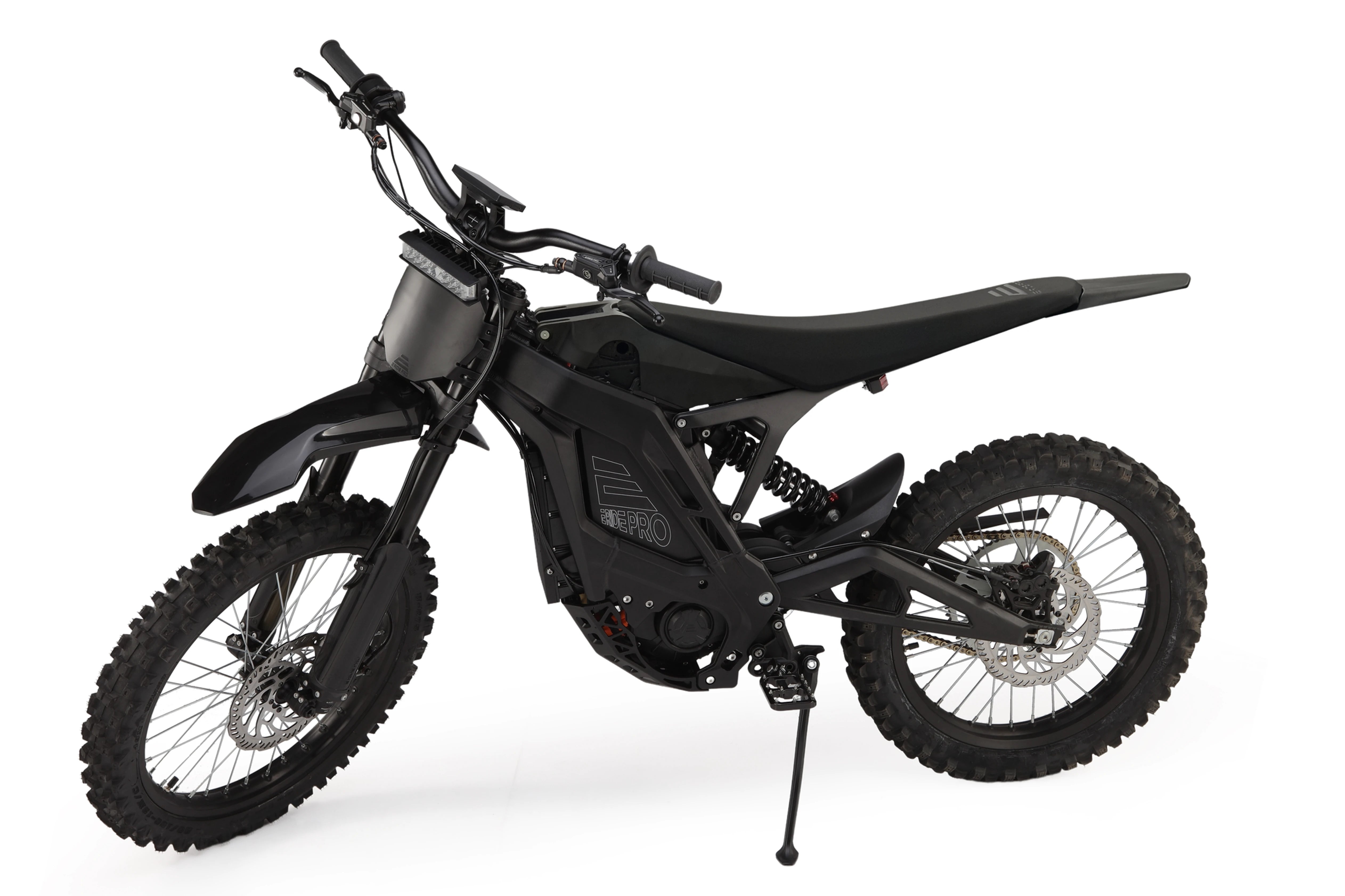
The E-Ride Pro SS 3.0 offers one of the lowest published seat heights in the high-performance 72V segment — approximately 830 mm — with 18 kW of peak power, a 3,600 Wh battery, and Bluetooth tuning that lets you configure power output per mode via smartphone.
This combination is particularly useful for riders with a lower inseam who don't want to sacrifice performance. The ability to configure Eco mode at reduced output means the bike can be tamed to a manageable starting point, with Sport and full 18 kW available as skill develops.
Why it works for fit-conscious experienced riders:
- ~830 mm is among the lowest seat heights available at 18 kW peak power
- Bluetooth app tuning allows genuine power reduction in each mode — not just a token Eco setting
- 76 kg same weight as the MX5 Pro
- 3,600 Wh battery provides 45–55 miles real-world range in Sport mode
- Available in L1e (street legal, 45 km/h) and L3e variants — adds street usability
The honest trade-off: 18 kW in full Sport or Race mode is a genuinely powerful machine. This bike is best suited for riders who have developed off-road experience and can manage instant torque responsibly. The Bluetooth tuning helps significantly with this, but it requires the rider to configure it deliberately.
Available at vectorebike.com: E-Ride Pro SS 3.0 — 18 kW L1e/L3e/Offroad
4. E-Ride Pro SR — Maximum Performance, Still Accessible
Seat height: ~830 mm (32.7 in.) | Weight: 83 kg (183 lbs) | Power: 25 kW | Battery: 72V 50Ah (3,600 Wh)
The E-Ride Pro SR is the highest-output model in the vectorebike.com range, with 25 kW peak power and 630 Nm of wheel torque. It shares the ~830 mm seat height of the SS 3.0 — making it, in theory, the most powerful emoto available with an accessible seat height.
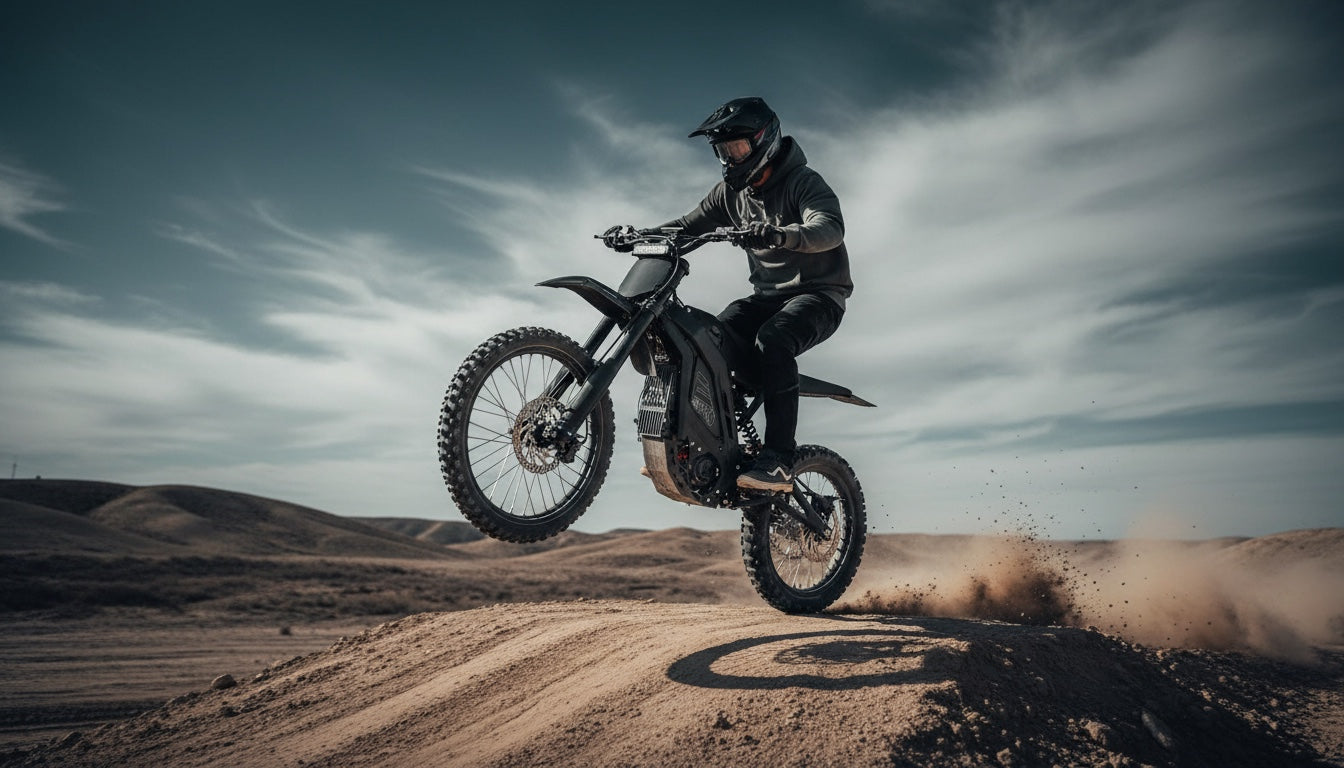
In practice, the SR is appropriate only for experienced riders who are fully prepared to manage its power. The 83 kg weight is more demanding than the 76 kg SS 3.0 in slow-speed and recovery situations. And 25 kW with full throttle in Race mode will wheelie at any speed — a characteristic that requires confident, experienced hands.
Why it's on this list: The SR's seat height (~830 mm) is genuinely lower than many competitors with half its power output. For an experienced, compact-framed adult rider who wants maximum performance without the seat height penalties of full-size motocross bikes, the SR is a realistic option — with the understanding that the Bluetooth tuning should be used to limit power during the first months of ownership.
Available at vectorebike.com: E-Ride Pro SR — 25 kW L1e/L3e/Offroad
Comparison Table: Best Models for Riders with a Lower Inseam
|
Model |
Seat Height |
Weight |
Peak Power |
Top Speed |
Battery |
Best Rider Profile |
|
Talaria X3 Pro (XXX) |
~805 mm (31.7 in.) |
55 kg |
5 kW |
75 km/h |
60V 40Ah |
Beginners, urban/trail, first e-moto |
|
Talaria Sting MX5 Pro |
840 mm (33.1 in.) |
76 kg |
13 kW |
95 km/h |
72V 40Ah |
Intermediate, technical trails |
|
E-Ride Pro SS 3.0 |
~830 mm (32.7 in.) |
76 kg |
18 kW |
100 km/h |
72V 50Ah |
Advanced, trail + street (L1e/L3e) |
|
E-Ride Pro SR |
~830 mm (32.7 in.) |
83 kg |
25 kW |
110 km/h |
72V 50Ah |
Experienced, maximum performance |
Seat heights are manufacturer-published figures. Real-world reach depends on suspension setup, rider posture, and boot sole thickness.
Lightweight vs Full-Size Electric Dirt Bikes: What the Weight Difference Feels Like
There is a meaningful difference between riding a 55 kg bike (Talaria X3 Pro) and a 76 kg bike (Talaria MX5 Pro or E-Ride Pro SS 3.0). And a further meaningful difference between 76 kg and 83 kg (E-Ride Pro SR).
Where you feel the weight most:
At trail speeds on open terrain, you probably won't feel the difference. Modern frames are well-balanced and the weight is low and centered.
You will feel the difference in three specific situations:
- Recovering from a tip-over — lifting 76 kg solo on a slope is a different physical challenge than lifting 55 kg
- Slow technical riding — holding the bike stable with one foot down while navigating obstacles requires more strength on heavier platforms
- Loading and transporting — putting the bike in a van or onto a ramp matters if you ride solo
For riders with a lighter build or less upper-body strength, this weight difference is not trivial. The Talaria X3 Pro at 55 kg is significantly more forgiving in all three of these situations — which is why it's the recommended starting point regardless of budget if fit and manageability are priorities.
The key principle: Start on the lightest platform that meets your performance needs. Moving up in weight and power is a natural progression. Moving down is more expensive and less satisfying.
Best Beginner Choice for Riders with a Lower Inseam
If you're new to electric dirt bikes and have a lower inseam, the Talaria X3 Pro (XXX) is the right first bike from the vectorebike.com lineup — without significant qualification.
Here's why:
805 mm seat height means most adults over 160 cm can place a foot flat on the ground. That confidence at stops removes one of the most common sources of beginner anxiety.
55 kg weight means that when you drop the bike — and beginners drop bikes — you can pick it back up. On a 76 kg machine, a solo recovery on a slope or in mud is a genuine physical challenge. On a 55 kg bike, it's manageable.
5 kW power output with progressive delivery means the bike won't surprise you. There's enough power to ride real trails and reach genuine speeds, but the delivery is smooth enough that throttle control mistakes don't result in immediate loss of control.
The X3 Pro is available in an L1e street-legal configuration, which also means you can ride it to the trailhead legally in most EU countries with a standard Category B driving licence.
View the Talaria X3 Pro (XXX) at vectorebike.com →
Features to Prioritize Before Buying
When evaluating any electric dirt bike for fit, these features matter most — in roughly this order:
1. Seat height under 840 mm This is the practical threshold at which most adults up to approximately 170 cm can achieve confident footing. Above this, tiptoe management is required, which is learnable but adds cognitive load.
2. Suspension adjustability Check whether the front forks allow preload adjustment and whether the rear shock has adjustable preload. A 10–15 mm reduction in suspension sag can translate to a meaningful improvement in standing reach.
3. Genuine power mode reduction Look for bikes where Eco mode represents a significant real-world power reduction — not just 10–15%. The E-Ride Pro's Bluetooth tuning allows configuration down to 30–40% output, which is a genuinely different riding experience than Sport mode.
4. Bike weight under 60 kg for beginners The 55 kg Talaria X3 Pro is the only model in the vectorebike.com range that meets this threshold. For riders progressing beyond beginner level, 76 kg is manageable; the trade-off is power and performance.
5. Handlebar adjustability A bike with the right seat height can still feel too large if the handlebars require stretching to reach. Look for models where the handlebar position is adjustable or where aftermarket stem options are well-supported. The E-Ride Pro models come with a direct stem mount that raises handlebar height, which improves reach for many riders.
6. Test rides available Vectorebike.com offers test rides — this is worth taking advantage of. Seat height measurements describe a static sitting position. How a bike actually feels at low speed and during slow-speed balance is only understood through riding.
Common Mistakes Riders with a Lower Inseam Make
Buying for the spec sheet instead of the fit A 25 kW bike is impressively powerful on paper. It's also harder to manage when you can't reach the ground confidently at a stop. Impressive power doesn't compensate for poor ergonomic fit — it amplifies the consequences.
Treating seat height as the only relevant measurement A bike with 830 mm seat height and 83 kg weight is not automatically a better fit than a bike with 840 mm seat height and 55 kg weight. The lighter bike is more forgiving in every slow-speed and recovery situation, even with a marginally higher seat.
Not adjusting suspension before concluding the bike doesn't fit Many riders try a bike, find the seat is slightly high, and assume the model is wrong for them. Before drawing that conclusion, ask about suspension preload adjustment. A 10–15 mm reduction through suspension setup changes the accessible range of the bike significantly.
Skipping the beginner stage to save future upgrade costs "I'll buy the powerful bike now so I don't need to buy twice" is a common rationale. The problem is that riding a 76 kg, 18 kW bike without the skill to manage it confidently doesn't accelerate learning — it makes every ride more stressful and less educational. The X3 Pro is not a compromise bike; it's a genuinely fun machine that builds exactly the skills you'll use on more powerful platforms.
Ignoring L1e variants for everyday use If you're primarily using the bike for commuting with occasional off-road sessions, L1e certification makes the bike street-legal in most EU countries with a standard licence. The E-Ride Pro SS 3.0 and Talaria X3 Pro are both available in L1e configuration at vectorebike.com — which meaningfully expands their practical utility.
Which Type of Rider with a Lower Inseam Needs Which Type of Bike?
|
Rider Profile |
Recommended Model |
Primary Reason |
|
Complete beginner, first e-moto |
Lowest seat height (805 mm) + lightest weight (55 kg) in the lineup |
|
|
Beginner wanting street legality (L1e) |
Lowest seat, lightest weight, available with L1e certification |
|
|
Intermediate rider, trail focus |
840 mm seat, smooth gearbox delivery, 13 kW real performance |
|
|
Advanced rider, street + trail (L1e/L3e) |
~830 mm seat, 18 kW, Bluetooth tuning, L1e/L3e available |
|
|
Experienced rider, maximum performance |
~830 mm seat despite 25 kW output; requires experience |
|
|
Rider prioritising range over power |
Samsung 50S battery, efficient gearbox, up to 100 km at 25 km/h |
Final Verdict
The right electric dirt bike for a rider with a lower inseam is the one where the physical fit enables confident, safe, and enjoyable riding — not the one with the most impressive spec sheet.
If you are new to electric dirt biking: Start with the Talaria X3 Pro (XXX). The 805 mm seat height, 55 kg weight, and progressive 5 kW power make it the most accessible and forgiving bike in the vectorebike.com lineup. You will not outgrow it in the first season, and the skills you build on it transfer directly to more powerful platforms.
If you have off-road experience and want real performance: The Talaria Sting MX5 Pro at 840 mm offers the best combination of accessible seat height and genuine 13 kW trail performance in the 72V tier. Its gearbox power delivery is specifically well-matched to riders who want precise throttle control.
If you are an experienced rider who wants maximum performance without a high seat: The E-Ride Pro SS 3.0 at ~830 mm delivers 18 kW with Bluetooth-configurable power — the lowest seat height available in the high-performance tier of the lineup.
All models are available at vectorebike.com with free delivery across the EU, a 27-month warranty, and the option for a test ride before purchase.
Book a test ride at vectorebike.com →
FAQ
What is the best electric dirt bike for riders with a lower inseam?
For most riders prioritising fit and accessibility, the Talaria X3 Pro (XXX) is the best choice from the vectorebike.com range: 805 mm seat height, 55 kg weight, and 5 kW of progressive power. Riders with off-road experience who want more performance should look at the Talaria MX5 Pro (840 mm, 13 kW) or E-Ride Pro SS 3.0 (~830 mm, 18 kW).
Is seat height the most important factor?
It's the most obvious factor, but not the only one. Weight matters as much or more in slow-speed control and tip-over recovery. A 55 kg bike that requires slight tiptoe is often more manageable than a 76 kg bike with the same seat height. Always evaluate seat height and weight together.
Are lightweight electric dirt bikes easier for beginners?
Yes, consistently. A lighter bike requires less physical effort in the situations where beginners struggle most: slow-speed balance, tip-over recovery, and navigating tight technical sections. The Talaria X3 Pro at 55 kg is significantly more forgiving than any 76 kg alternative, even at the same power level.
Can a rider with a shorter inseam handle a full-size electric dirt bike?
With experience and appropriate suspension setup, yes. The E-Ride Pro SR at 25 kW and ~830 mm seat height is a realistic option for an experienced, compact-framed rider who configures the bike's power carefully via Bluetooth tuning. But for anyone still developing off-road skill, starting on a lighter and lower platform builds confidence and technique more effectively.
Which is better for a rider with a lower inseam: more power or less weight?
Less weight, until skill level justifies more power. This is consistent advice from instructors and experienced riders across the emoto community. A 55 kg bike with 5 kW teaches control faster than a 76 kg bike with 18 kW teaches control. Once the fundamentals are solid, adding power within the same weight class is the right progression.
How do I know if an electric dirt bike fits me properly?
Three checks: (1) Sit on the bike in riding position — can you place at least one foot flat on the ground, or comfortably tiptoe with both feet? (2) Stand on the footpegs with your knees slightly bent — this is the standard off-road riding position. Does it feel natural or cramped? (3) Grip the handlebars in riding position — are your arms slightly bent, or fully extended? If any of these three checks feel significantly off, the bike needs adjustment or is the wrong platform.
Vectorebike.com offers test rides for all models. We strongly recommend taking one before purchasing — seat height numbers describe static measurements, but how a bike actually feels at low speed is something only riding can tell you.


