

Författare: Artur Ragulskyi | VD & Grundare
Lästid: ~12 minuter
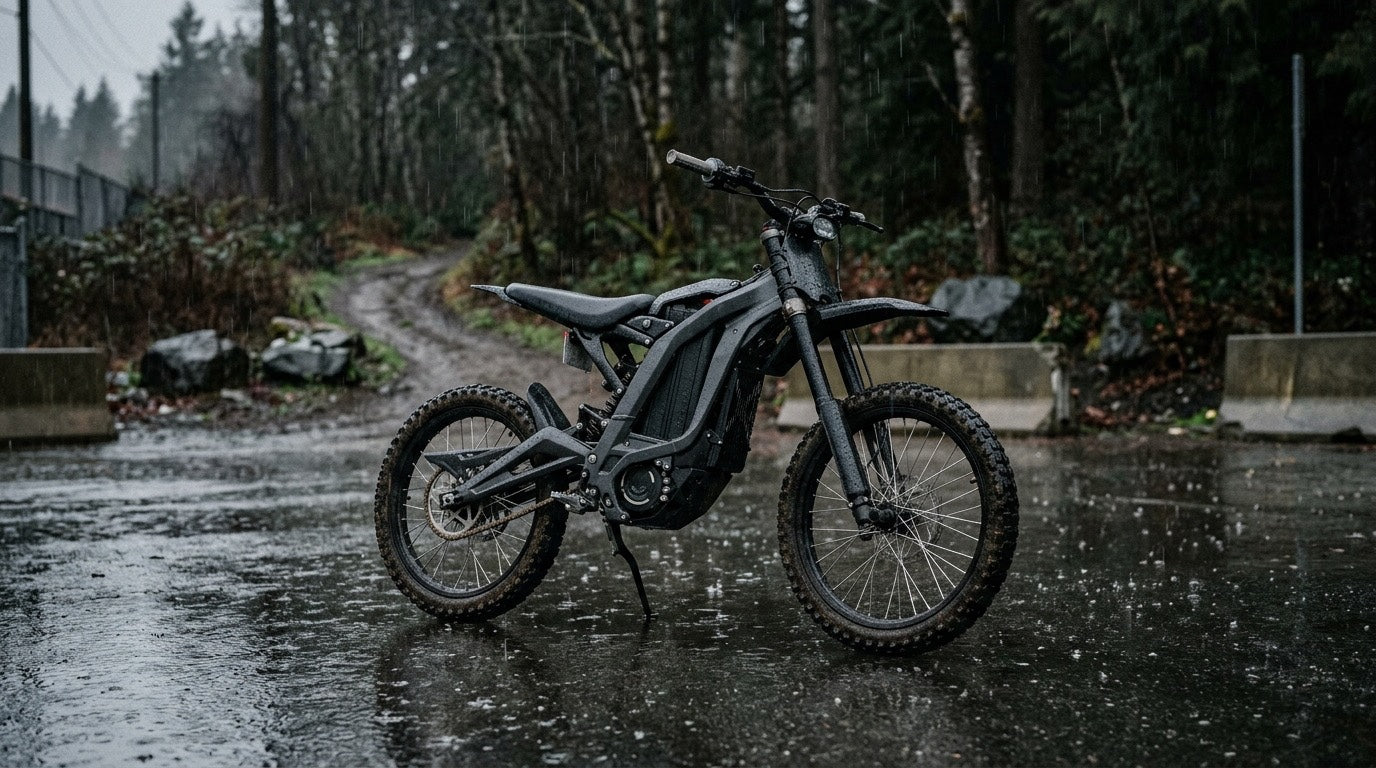
Ja — du kan köra en E Ride Pro-elmotorcykel i regnet.
Det är det korta svaret.
Men det mer korrekta svaret är detta: E Ride Pro-elmotorcyklar är byggda för att klara normal körning i vått väder, inklusive regn, snö, våta vägar, pölar och lera — men de är inte avsedda att sänkas ner i vatten eller utsättas för vårdslös högtryckstvätt.
Den skillnaden är viktig.
Många kunder frågar om E Ride Pro-elmotorcyklar är "vattentäta." I verkligheten menar de oftast:
- Kan jag köra i regnet utan att skada den?
- Är batteriet skyddat?
- Kommer motorn att klara våta vägar och pölar?
- Kan jag tvätta elmotorcykeln med vatten?
- Vad bör jag undvika om jag vill att elmotorcykeln ska hålla länge?
Efter år av att bygga våra egna elmotorcyklar, sälja och serva prestanda elmotorcyklar och se hur dessa maskiner beter sig i verkliga livet, är mitt svar tydligt:
Regn är inte problemet. Dåliga vanor vid exponering för vatten är problemet.
I den här artikeln förklarar jag vad det betyder i praktiken för alla E Ride Pro-modeller — inklusive E Ride Pro SR, SS 3.0, SS 2.0, SE och Mini.
Det korta svaret: Är E Ride Pro-elmotorcyklar vattentäta?
E Ride Pro-elmotorcyklar beskrivs bäst som väderbeständiga, inte helt vattentäta på det sätt som många föreställer sig.
Enligt tillverkaren är dessa elmotorcyklar designade för att köras i regn, snö och normalt dåligt väder, och vädret i sig bör inte vara ett problem vid normal körning. Tillverkaren erbjuder också två års garanti — förlängd till 27 månader (24+3) vid köp genom vectorebike.com — vilket ger kunderna förtroende för att elmotorcyklarna är avsedda för verklig användning, inte bara torra utställningsförhållanden.
Det finns dock en viktig begränsning:
Motorn bör inte sänkas ner i vatten.
Stänkande vatten, våta vägar, lera och regn är okej. Men att köra genom djupt vatten, bäckar eller översvämmade områden som är djupare än elmotorcykelns markfrigång rekommenderas inte.
Det beror inte på att elmotorcykeln är ömtålig. Det beror på hur elmotorer beter sig när de är varma och plötsligt utsätts för kallt vatten.
IP-klassning: Vad siffrorna egentligen betyder
E Ride Pro-batterier beskrivs som väderbeständiga för normal körning i vått väder. Kontrollera den aktuella produktsidan för exakt skyddsklassning för din specifika modell. Att förstå vad detta betyder — och vad det inte betyder — är avgörande för beslut om körning i vått väder.
|
IP-klassning |
Dammsskydd |
Vattenskydd |
|
IP65 |
Fullständigt dammtät |
Skyddad mot vattenstrålar från alla riktningar |
|
IP67 |
Fullständigt dammtät |
Skyddad mot tillfällig nedsänkning upp till 1 meter i 30 minuter |
|
IP68 |
Fullständigt dammtät |
Skyddad mot kontinuerlig nedsänkning djupare än 1 meter |
Vad IP67 betyder för E Ride Pro-ägare:
|
Scenario |
IP67-status |
Verklighet |
|
Körning i kraftigt regn |
✅ Skyddad |
Helt okej |
|
Våta vägar, pölar |
✅ Skyddad |
Helt okej |
|
Körning i lera, stigkörning |
✅ Skyddad |
Okej med eftervård |
|
Trycktvätt med lågt tryck |
⚠️ Använd försiktighet |
Undvik känsliga områden |
|
Högtrycksstråle på kontakter |
❌ Inte skyddad |
Kan tvinga vatten förbi tätningar |
|
Motor nedsänkt medan den är varm |
❌ Inte designad för detta |
Risk för termisk chock (se nedan) |
|
Långvarig djup nedsänkning |
❌ Utanför IP67-specifikation |
Inte rekommenderat |
Viktigt: IP67-tester utförs under kontrollerade laboratorieförhållanden på statiska komponenter i rumstemperatur. Verklig körning introducerar variabler — värme, vibration, kontaktors ålder, tryckskillnader — som IP67-testet inte kan efterlikna. Tänk på IP67 som en miniminivå, inte en licens för vårdslös exponering för vatten.
Varför djupt vatten är farligt för motorn
Detta är en av de viktigaste sakerna som förare behöver förstå.
Om motorn är varm och du plötsligt kör in i kallt vatten, kyls luften inuti snabbt. Det skapar ett lägre internt tryck, och motorn kan börja dra in utomhusluft och fukt genom små springor, kabelingångar och tätningar.
Enkelt uttryckt: en varm motor kan suga in vatten förvånansvärt snabbt.
I vissa fall kan fukt till och med färdas längs kabelvägar som ett sugrör.
Därför är mitt råd mycket enkelt:
|
Förhållande / Användningsfall |
Rekommendation |
|
Att köra i regn |
✅ Okej |
|
Att köra på våta vägar |
✅ Okej |
|
Att köra i lera |
✅ Okej |
|
Att plaska genom pölar |
✅ Vanligtvis okej |
|
Att helt sänka ner motorn i vatten |
❌ Inte rekommenderat |
|
Att korsa en kall bäck med en varm motor |
❌ Definitivt inte rekommenderat |
Om du kommer ihåg bara en sak från den här artikeln, kom ihåg det.
Kan du köra en E Ride Pro i regn?
Ja, absolut.
Både från tillverkarens riktlinjer och verklig erfarenhet bör det inte vara något problem att köra en E Ride Pro i regn. Detsamma gäller för snö och normalt vått väder.
Vi säger samma sak till kunderna: Använd elmotorcykeln i regn, i snö, i dåligt väder — använd bara sunt förnuft.
Dessa elmotorcyklar är designade för att användas utomhus. Normal exponering för regn, våta vägar, leriga stigar och fuktiga körförhållanden är en del av verkligt ägande.
Det som spelar roll är inte om elmotorcykeln blir våt under användning. Det som spelar roll är:
- om du undviker djup nedsänkning
- om du undviker att spruta känsliga delar med vatten under högt tryck
- om du torkar elmotorcykeln ordentligt efteråt
- om du skyddar viktiga lager och kontakter över tid
Det är den verkliga skillnaden mellan en elmotorcykel som håller och en som utvecklar förebyggbara problem.
E Ride Pro Modelljämförelse: Hänsyn vid vått väder
Olika modeller har något olika hänsyn vid vått väder baserat på konstruktion, elektronik och avsedd användning. Här är en praktisk översikt:
|
Modell |
Batteri |
Motor / Kylning |
Anmärkningar om vått väder |
|
72V 50Ah, IP67 |
25 kW, aktiv vätskekylning |
Kylsystemet behöver rena intag efter leriga turer |
|
|
72V 50Ah, IP67 |
15,8 kW, passiv kylning |
Standard försiktighetsåtgärder vid vått väder gäller |
|
|
72V 40Ah, IP67 |
12 kW, passiv kylning |
Standard försiktighetsåtgärder vid vått väder gäller |
|
|
72V 40Ah, IP67 |
10 kW, passiv kylning |
Lättast på 63 kg — enklare torkning efter körning |
|
|
60V 30Ah, IP67 |
6 kW, passiv kylning |
Mest kompakta ramen — kontrollera kontaktkåpor efter lera |
Notering om SR:s aktiva kylsystem: SR använder en aktiv vätskekylningskrets för att hantera värmen vid kontinuerlig 25 kW drift. Efter leriga enduroturer är det värt att säkerställa att kylsystemets intag är fria från kompakterat skräp innan nästa session.
Kan du tvätta en E Ride Pro Elmotorcykel?
Ja, men tvätta den med omsorg.
Det är här många förare skapar problem som inte behövde uppstå.
Bästa metoden för lätt smuts: Använd en fuktig mikrofiberduk och torka av elmotorcykeln. Det räcker mer än väl för normal rengöring och undviker onödig vattenexponering på känsliga områden.
Om elmotorcykeln är mycket smutsig: Om du har kört off-road och elmotorcykeln är täckt av lera kan du tvätta den med vatten — och till och med använda en högtryckstvätt försiktigt. Men det finns regler.
Sikta INTE stark vattenstråle mot:
- Motorn
- Batteriområdet och laddningsporten
- Kontrollenheten (vanligtvis monterad bak)
- Displayen och TFT-skärmen
- Knappar och reglage
- Tändningsnyckelområdet
- Kontaktfack
- Kabelingångar
Säker tvättmetod:
- Låt elmotorcykeln svalna i 15–20 minuter efter körning innan du tvättar
- Skölj ramen och hjulen med låg till medelhög tryck från ett avstånd på minst 30 cm
- Använd en mjuk borste och milt tvålmedel för envis lera på ramen
- För känsliga områden — display, kontakter, kontrollzon — använd endast en fuktig trasa
- Torka med en ren trasa; var särskilt noga med display, knappar och kontaktkåpor
- Applicera en lätt skyddande spray (silikonbaserad, elektronikvänlig) på kontaktkåpor om du kör i ihållande våta förhållanden
De största tvättfelen sker när förare behandlar elmotorcykeln som en helt tätad terrängbil och aggressivt sprayar varje söm och kontakt på nära håll. Så börjar undvikbara vattenproblem.
De mest känsliga områdena på en E Ride Pro i våta förhållanden
Största delen av elmotorcykeln hanterar fukt väl. Men vissa delar kräver extra omsorg. Här är var du ska fokusera din uppmärksamhet:
|
Komponent |
Risknivå |
Varför |
Vad man ska göra |
|
Batteritopp / laddningsport |
⚠️ Medel |
Övre anslutningsområde exponerat |
Undvik direkt vattenflöde; torka av |
|
Motorkabelutgångar |
⚠️ Medel |
Risk för termisk chock vid heta ytor |
Ingen nedsänkning; undvik direkt vattenstråle |
|
Styrenhetsområde |
⚠️ Medel |
Elektronik tätad men inte jet-säker |
Ingen direkt högtryckstvätt |
|
TFT-display |
⚠️ Medel–Hög |
Söm kan släppa in fukt |
Endast trasa; aldrig direkt vattenstråle |
|
Knappar / tändning / reglage |
⚠️ Medel |
Strömbrytare inte nedsänkningsklassade |
Undvik direkt blötläggning; torka av |
|
Kontakter |
🔴 Hög |
Vanligaste verkliga vattenproblemet |
Mest kritiskt att skydda — endast trasa |
|
Styrhuvudslager |
⚠️ Medel |
Exponerade för vägspolning |
Smörj regelbundet; årlig kontroll |
|
Hjul- / svängarmslager |
⚠️ Medel |
Vägsalt och lerangrepp |
Vattentätt fett; inspektera säsongsvis |
Ett verkligt kundfall: När vatten orsakade problem
Vi har sett vattenrelaterade problem — inte från normal körning i regn, utan från felaktig tvätt.
I de fall jag har sett tog kunder elmotorcykeln till en tvättstation och riktade en stark vattenstråle in i kontaktutrymmet ovanför styrenheten, under tändningsnyckelområdet. Det gjorde att vatten kom in i några av kontakterna.
I de situationerna var mitt råd:
- Torka elmotorcykeln noggrant
- Torka kontakterna ordentligt — tryckluft hjälper
- Tillsätt extra vattentätning (dielektriskt fett på kontakter) där det är lämpligt
- Undvik att upprepa samma tvättmetod
Det här är ett perfekt exempel på varför den verkliga frågan inte är "Kan den bli blöt?" Den bättre frågan är: "Hur kommer vattnet in?"
Regn är normalt. Att tvinga in vatten i elektriska kontaktpunkter är det inte.
Saltvatten, vintervägar och kustkörning — extra uppmärksamhet krävs
Om du bor nära havet, kör på vintervägar med vägsalt eller förvarar elmotorcykeln i en fuktig miljö finns ett extra problem: korrosion och lagerförslitning.
Vatten i sig är en sak. Saltvatten och vägsalt är betydligt mer aggressiva — salt påskyndar korrosion av metalldelar och förstör lagerfett snabbt.
De områden som är mest sårbara för saltangrepp:
- Styrhuvudslager
- Navlager
- Länkage och svängarmslager
- Exponerade bultskallar och gänggränssnitt
- Kedja och drev (både Talaria växellådskedja och drivkedjor)
Rekommenderat skydd för tyska vinterförare:
I Tyskland saltas vägarna kraftigt under vintermånaderna — särskilt i Bayern, där temperaturerna regelbundet når −2°C till −5°C i januari. Om du pendlar på en väglegal L1e-modell under vintern är några extra steg värda ansträngningen:
- Applicera högkvalitativt vattentätt fett på alla lager innan vintersäsongen (september/oktober)
- Skölj ramen och undersidan med färskt vatten efter varje saltad vägkörning — saltrester fortsätter att angripa metallen även när elmotorcykeln står parkerad
- Applicera korrosionsskydd på exponerade bultskallar och kontaktkåpor
- Kontrollera kedjespänning och smörjning var 200–300 km vinterkörning; saltförorenade kedjor slits dramatiskt snabbare
- Förvara elmotorcykeln inomhus när det är möjligt — ett oisolerat men torrt garage är betydligt bättre än att stå ute
För reservdelar inklusive kedjor, kontakter och lagerkomponenter, se vectorebike.com komponentsektion.
Det värsta du kan göra efter att ha kört i regnet
Den absolut sämsta vanan är denna: att lämna elmotorcykeln blöt i ett fuktigt utrymme och inte göra något.
Om elmotorcykeln förblir blöt i ett fuktigt garage, kallt rum eller dåligt ventilerat förvaringsutrymme torkar den inte riktigt ordentligt. Fukt blir kvar runt skärmar, knappar, kontakter och metalldelar — och då ökar risken för kondens och långsiktiga vattenrelaterade problem.
Rutinen efter regn (tar under 5 minuter):
- ☑ Flytta elmotorcykeln till en torr, ventilerad plats
- ☑ Torka display, knappar och styregenskaper med en torr trasa
- ☑ Kontrollera och torka batterikontaktens hölje
- ☑ Torka av ramen för att förhindra att lera torkar och packas
- ☑ Låt elmotorcykeln lufttorka helt innan du täcker över eller förvarar den
- ☑ Om du kör på vintern/salt: skölj med färskt vatten innan torkning
Detta kräver mycket liten ansträngning, men minskar dramatiskt risken för framtida problem.
Extremt fall: Vad vi vet från egen erfarenhet
Vårt perspektiv är inte bara teoretiskt.
Vi bygger våra egna elmotorcyklar, och några av våra äldsta maskiner har rullat i 7, 8, till och med 9 år. När kunder följer våra råd om skötsel, torkning, fettbeskydd och förnuftig rengöring har de vanligtvis inga allvarliga vattenrelaterade problem.
Vi har också sett extrema fall.
En av våra elmotorcyklar i Finland föll en gång genom isen och låg under vatten i ungefär en dag. Kunden hämtade upp den nästa dag. Efter torkning och inspektion klarade motorn sig, batteriet klarade sig, och batteriskyddssystemet gjorde sitt jobb. Styrenheten klarade sig inte — troligen en kortslutning eller vattenrelaterat elektriskt fel — men att resten av elektroniken överlevde en så extrem händelse säger mycket.
Det är uppenbarligen inte normal användning, och jag skulle aldrig presentera det som tillåtelse att doppa elmotorcykeln.
Men det visar något viktigt: dessa system är tuffare än många tror.
Mitt ärliga omdöme: Regn är okej, missbruk är det inte
Om en kund frågar mig, "Kan jag köra en E Ride Pro i regnet?" är mitt ärliga svar:
Ja, 100 %. Kör i regn, kör i snö, tvätta den om det behövs — gör det bara med sunt förnuft.
Elmotorcykeln är inte gjord av socker. Den är till för att användas.
Men samtidigt skulle jag aldrig säga att det är en ubåt.
Gör inte:
- Doppa inte motorn
- Kör inte genom djupt vatten
- Spraya inte tryck direkt in i kontakter, displayer och elektronik
- Lämna elmotorcykeln våt i en fuktig miljö i flera dagar
- Ignorera inte lager-skydd om du kör i hårda våta eller salta förhållanden
Gör:
- Kör i regn, snö och normala våta förhållanden med självförtroende
- Rengör elmotorcykeln — men försiktigt och med rätt metod
- Torka den ordentligt efter varje våta tur
- Skydda lager och kontakter med lämpligt fett
- Förvara den på en torr plats
Om du undviker dessa misstag bör användning i vått väder inte vara något problem.
Säker körning i vått väder: Komplett checklista
Innan körning i våta förhållanden
- Kontrollera däcktrycket — kalla våta vägar minskar effektivt grepp
- Kontrollera bromshandtagets känsla — hydrauliska skivbromsar på E Ride Pro-modeller fungerar pålitligt i vått väder, men verifiera funktionen innan körning
- Bekräfta batteriets laddningsnivå — kalla temperaturer minskar effektiv kapacitet med 15–25 % under tyska vinterförhållanden
Under körning i vått väder
- Lämna extra bromssträcka — inte på grund av bromsarna, utan för att däckets grepp på våt asfalt eller våta rötter är nedsatt
- Undvik att köra genom djupt vatten — särskilt om motorn är varm efter körning
- Var uppmärksam på våta målade ytor, spårvagnsspår och brunnslock (särskilt relevant för L1e stads-pendlare)
Efter körning i vått väder
- Torka av display, knappar och styregenskaper
- Kontrollera och torka batterikontaktens hölje
- Inspektera kedjans spänning och smörjningstillstånd
- Om saltade vägar varit inblandade — skölj med färskt vatten innan torkning
- Låt lufttorka helt i ett ventilerat utrymme innan förvaring
-
Efter längre våta pass — kontrollera lagren för skrovlighet eller glapp
Frågor om underhåll vid vått väder, skydd av kontakter eller lagerfett för din specifika modell? Kontakta vectorebike.com-teamet via FAQ-sidaMed över 11 års erfarenhet av service på E Ride Pro, Talaria och Vector elmotorcyklar i Tyskland kan vi ge råd om modell-specifik underhåll för dina körförhållanden.
FAQ
Can I ride an E Ride Pro bike in heavy rain?
Yes. Heavy rain itself should not be a problem during normal riding. The main thing to avoid is deep water submersion or forcing water into sensitive electrical areas.
Are E Ride Pro bikes waterproof?
Not in the sense of being designed for full submersion. They carry an IP67 battery rating and are weather-resistant for normal rain and wet-weather riding. The accurate description is: weather-resistant, not submarine-proof.
Can I wash an E Ride Pro with a pressure washer?
You can, but with strict care. Do not aim the jet directly at the motor, battery, controller, display, buttons, ignition area, or connectors. Use low-to-medium pressure from a distance and avoid all electrical connection points.
Why is deep water bad for the motor?
If the motor is hot and suddenly enters cold water, the internal air cools quickly and creates pressure differentials that can pull moisture inside through cable entries and seals.
What parts need the most protection from water?
Display, buttons, connector areas, controller area, motor cable exits, and the upper battery connection points. These are the areas where forced water exposure (from pressure washing) creates the most problems in real-world use.
What should I do after riding in the rain?
Wipe off visible moisture from the display and controls, check and dry the battery connector housing, and let the bike dry in a warm, dry, ventilated place.
Is salt water or winter road salt worse than rain?
Yes — significantly. Salt is much more aggressive and attacks bearings and metal surfaces even after the visible moisture dries. Use waterproof grease on all bearing assemblies and rinse with fresh water after every ride on salted German winter roads.
What should I do after riding in the rain?
Wipe off visible moisture from the display and controls, check and dry the battery connector housing, and let the bike dry in a warm, dry, ventilated place.
Does wet riding affect the battery range?
Indirectly, yes. Cold temperatures (common in German winter wet-weather riding) reduce effective battery capacity by approximately 15–25% at 0°C and up to 30% at −5°C. Allow the battery to warm to room temperature before a cold wet-weather ride. For full guidance: Complete Guide to Electric Dirt Bike Battery Care.
Is this the same for Talaria and Vector models?
The same core principles apply to Talaria bikes and Vector bikes. All carry IP67 battery ratings. The Vector Vortex's motor-on-swingarm mid-drive design has different water exposure geometry than hub-drive models — the motor sits higher and further from deep-water zones during typical crossings.